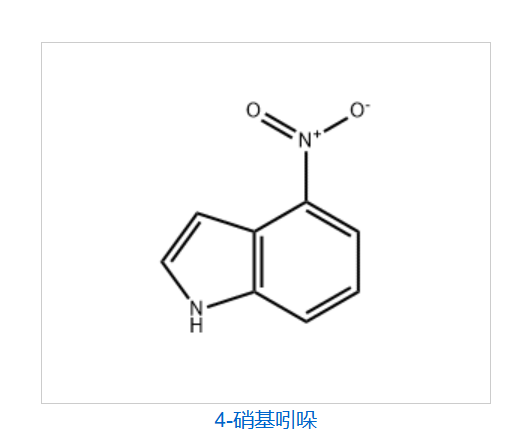
4-硝基吲哚化学性质熔点:205-207°C(lit.)沸点:288.82°C(roughestimate)密度:1.3264(roughestimate)折射率:1.5770(estimate)储存条件:Keepindarkplace,Inertatmosphere,Roomtemperature溶解度:Acetone,Dichloromethane,EthylAcetate,Methanol形态:GranularPowder酸度系数(ChemicalbookpKa):14.76±0.30(Predicted)颜色:YellowBRN:136022InChI:InChI=1S/C8H6N2O2/c11-10(12)8-3-1-2-7-6(8)4-5-9-7/p-5,9HInChIKey:LAVZKLJDKGRZJG-UHFFFAOYSA-NSMILES:N1C2=C(C([N+]([O-])=O)=CC=C2)C=C1CAS数据库:4769-97-5(CASDataBaseReference)
*The following content is generated by AI and is for reference only.
4-Nitroindole is a specialized heterocyclic compound widely utilized in organic synthesis and pharmaceutical research. With the chemical formula C8H6N2O2 and CAS Registry Number 137-05-9, this yellow crystalline solid serves as a critical intermediate in the development of bioactive molecules. Structurally, it consists of an indole core substituted with a nitro group at the fourth position, which significantly influences its electronic properties and reactivity compared to unsubstituted indole.
The primary application of 4-nitroindole lies in medicinal chemistry, where it acts as a versatile building block for synthesizing complex nitrogen-containing heterocycles. Researchers frequently employ it to construct derivatives targeting specific biological pathways, including potential anti-inflammatory, antimicrobial, and anticancer agents. The nitro functionality offers a strategic handle for further chemical modification, allowing for reduction to amino groups or nucleophilic substitution reactions that expand structural diversity. Additionally, due to its ability to inhibit neuronal nitric oxide synthase (nNOS) upon metabolic activation, certain analogs derived from this scaffold are investigated for neuroprotective effects in models of ischemic stroke and neurodegenerative diseases.
Beyond pharmacology, 4-nitroindole finds utility in materials science, particularly in the creation of functional dyes and optical sensors. Its conjugated system absorbs light in the visible spectrum, making it suitable for developing chromogenic compounds. In industrial settings, it is used as a precursor for agrochemicals, contributing to the synthesis of novel pesticides and herbicides. Safety protocols are essential when handling this substance, as nitroaromatic compounds can be toxic and potentially explosive under specific conditions; thus, standard laboratory precautions regarding flammability and toxicity must be strictly observed. Overall, 4-nitroindole remains an indispensable tool for chemists seeking to innovate in drug discovery and advanced material design, bridging fundamental organic chemistry with practical therapeutic applications.


![8,16-Diazadispiro[6.1.6.2]heptadecan-17-one](https://eimg.pharmasources.com/image/product/20250403/ca91cba8b87e53fc879f8d8764873a40jpg)
![8-Oxa-1,3-diazaspiro[4.5]decane-2,4-dione](https://eimg.pharmasources.com/image/product/20250403/60fa7223d5a34f24138486ceea0ffb15jpg)
![6,8-Dioxo-5,7-diazaspiro[3.4]octane-2-carboxylic acid](https://eimg.pharmasources.com/image/product/20250403/02effeb5a7639bc84ff1f3add3c0c64fjpg)



 (All Rights Reserved)