Product Description
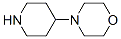
Huateng Pharma, a professional pharmaceutical intermediate supplier, provides 4-Morpholino piperidine (CAS No. 53617-35-9) with high quality and purity. It is an intermediate of Alectinib, a highly selective and potent anaplastic lymphoma kinase (ALK) inhibitor capable of blocking the resistant gatekeeper mutant, which results in reduced cell growth.
AI Product Description
*The following content is generated by AI and is for reference only.
4-Morpholinopiperidine is a versatile organic compound widely utilized in pharmaceutical research and chemical synthesis as a crucial heterocyclic building block. Chemically, it consists of a piperidine ring substituted at the fourth position with a morpholine group, creating a unique molecular architecture that combines two distinct nitrogen-containing rings. Its molecular formula is C9H18N2O, reflecting its composition of nine carbon atoms, eighteen hydrogen atoms, two nitrogen atoms, and one oxygen atom. The compound is identified by the CAS Registry Number 3769-05-3, which serves as its unique international identifier for safety data sheets, regulatory compliance, and inventory management across global supply chains.
In terms of physical properties, 4-morpholinopiperidine typically appears as a colorless to pale yellow liquid or low-melting solid, depending on purity and storage conditions. It possesses moderate basicity due to the presence of the secondary amine within the piperidine ring, making it an effective nucleophile in various substitution reactions. This reactivity profile renders it particularly valuable in the development of complex drug molecules, especially those targeting central nervous system disorders, including pain management, anxiety relief, and neurological conditions. Researchers frequently employ this molecule as an intermediate to synthesize more elaborate heterocycles found in modern therapeutic agents.
Beyond medicinal chemistry, 4-morpholinopiperidine finds applications in agrochemical formulations, where it aids in constructing bioactive compounds designed to protect crops from pests and diseases. Its structural versatility allows chemists to introduce specific steric and electronic modifications, optimizing binding affinity to biological targets while maintaining favorable pharmacokinetic properties. Furthermore, it serves as a ligand precursor in coordination chemistry, contributing to the design of novel metal complexes with potential catalytic or material science applications. Safety protocols dictate careful handling due to its potential irritant nature; proper ventilation and personal protective equipment are essential during laboratory manipulation. As the demand for advanced synthetic intermediates grows, 4-morpholinopiperidine remains a staple reagent in academic laboratories and industrial manufacturing facilities worldwide, underpinning innovations in drug discovery and functional material development.





 (All Rights Reserved)

![8,16-Diazadispiro[6.1.6.2]heptadecan-17-one](https://eimg.pharmasources.com/image/product/20250403/ca91cba8b87e53fc879f8d8764873a40jpg)
![8-Oxa-1,3-diazaspiro[4.5]decane-2,4-dione](https://eimg.pharmasources.com/image/product/20250403/60fa7223d5a34f24138486ceea0ffb15jpg)
![6,8-Dioxo-5,7-diazaspiro[3.4]octane-2-carboxylic acid](https://eimg.pharmasources.com/image/product/20250403/02effeb5a7639bc84ff1f3add3c0c64fjpg)