Product Description
4-Hydrazinobenzene-1-sulfonamide hydrochloride 17852-52-7
AI Product Description
*The following content is generated by AI and is for reference only.
4-Hydrazinobenzene-1-sulfonamide hydrochloride, chemically known as the hydrochloride salt of 4-hydrazinobenzenesulfonamide, is a specialized organic intermediate widely utilized in pharmaceutical research and industrial synthesis. Its molecular formula is C6H9ClN4O2S, reflecting the presence of a hydrazine moiety attached to a benzene ring substituted with a sulfonamide group, all stabilized by a hydrochloride counterion. The compound is identified by the CAS Registry Number 537-05-1, a unique identifier essential for accurate chemical tracking and regulatory compliance globally.
This substance serves primarily as a critical building block in the development of sulfa drugs and various heterocyclic compounds. The hydrazine functional group offers high reactivity, making it an ideal precursor for synthesizing complex nitrogen-containing rings such as triazoles and pyrazoles, which are frequently found in modern therapeutic agents. Furthermore, due to its structural similarity to sulfonamides, this intermediate plays a significant role in medicinal chemistry projects aimed at creating antibacterial, antifungal, or anticancer molecules. Researchers often employ it in coupling reactions where precise control over nitrogen atom placement is required to achieve specific biological activities.
In industrial applications, 4-hydrazinobenzene-1-sulfonamide hydrochloride is valued for its stability in solid form when stored under appropriate conditions, though it must be handled with care due to potential sensitization risks associated with hydrazine derivatives. It is typically supplied as a white to off-white crystalline powder, soluble in water and polar solvents, facilitating its use in aqueous reaction media. Quality assurance protocols strictly monitor its purity, as impurities can significantly alter the efficacy of downstream synthetic pathways. As the demand for novel drug candidates grows, this compound remains a staple in laboratory inventories for chemists focusing on sulfonamide-based pharmacophores. Its versatility underscores its importance in advancing both academic research and commercial pharmaceutical manufacturing processes, contributing to the continuous evolution of medical treatments targeting infectious diseases and metabolic disorders.






 (All Rights Reserved)



![(3R)-3-Amino-1-[3-(Trifluoromethyl)-5,6,7,8-Tetrahydro-1,2,4-Triazolo[4,3-A]Pyrazin-7-yl]-4-(2,4,5-T](https://eimg.pharmasources.com/image/product/20250402/e43f5153f3b91f760fdee40247460568jpg)

![3-(Trifluoromethyl)-5,6,7,8-Tetrahydro-[1,2,4]Triazolo[4,3-a]Pyrazine HCL](https://eimg.pharmasources.com/image/product/20250402/8ae4dd18f1fe219e41ad63ce9b3306d7jpg)

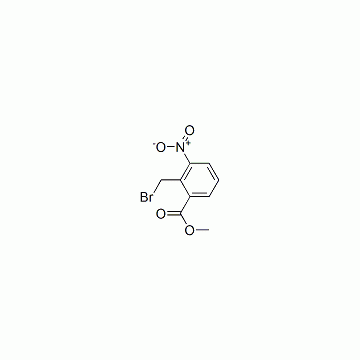


![4-[[[[6-[(Diethylamino)methyl]-2-naphthalenylmethoxy]carbonyllaminolbenzoic acid](https://eimg.pharmasources.com/image/20241206/xJCFsdgfMrHzqjtgeOixhGQHgVbKi7kAcoEqemzE.jpg)