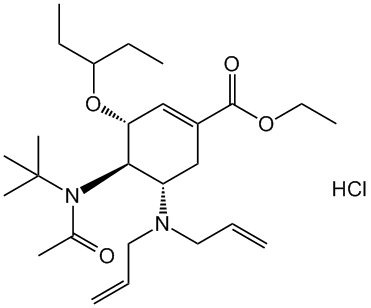
Huateng Pharmaceutical, a global supplier of pharmaceutical intermediates, offers oseltamivir intermediates (3R,4R,5S)-Ethyl 4-(N-(tert-butyl)acetamido)-5-(diallylamino)-3-(pentan-3-yloxy)cyclohex-1-enecarboxylate hydrochloride (CAS No.: 651324-08-2) for your requirements of R&D, evaluation, pilots and commercial along with supportive technical package required for evaluation.
*The following content is generated by AI and is for reference only.
The compound designated as (3R,4R,5S)-Ethyl 4-(N-(tert-butyl)acetamido)-5-(diallylamino)-3-(pentan-3-yloxy)cyclohex-1-enecarboxylic acid ester represents a highly specialized chiral intermediate within the realm of organic synthesis and medicinal chemistry. While specific commercial databases may not list a universally recognized CAS number for this exact stereoisomer due to its likely status as a custom-synthesized research material rather than a bulk commodity, its structural complexity indicates a sophisticated application profile. The molecule features a cyclohexene core substituted with distinct functional groups: an ethyl carboxylate moiety, a bulky tert-butyl acetamido group, a diallylamino side chain, and a pentan-3-yloxy ether linkage. Crucially, the stereochemical configuration at positions 3, 4, and 5 is explicitly defined as (3R,4R,5S), which is paramount for biological activity in pharmaceutical contexts where chirality dictates receptor binding affinity and metabolic stability.
This compound serves primarily as a key building block for the synthesis of complex bioactive molecules, particularly those targeting neurological or oncological pathways. The presence of the allyl groups suggests potential utility in ring-closing metathesis reactions or polymerization studies, while the amide and ether functionalities provide handles for further derivatization. In drug discovery pipelines, such intricate scaffolds are often employed to construct libraries of analogs aimed at optimizing pharmacokinetic properties or enhancing target selectivity. Researchers utilize these chiral precursors to investigate structure-activity relationships (SAR), ensuring that the final therapeutic agents possess the precise three-dimensional geometry required for efficacy. Furthermore, the specific stereochemistry implies that this material is intended for high-value applications where racemic mixtures would be ineffective or unsafe. Although currently limited to academic laboratories and specialized contract manufacturing organizations, compounds of this nature are instrumental in advancing next-generation therapeutics. Its production typically requires asymmetric synthesis techniques or chiral resolution methods to maintain the integrity of the R,R,S configuration. As the demand for precision medicine grows, the role of such tailored chiral intermediates becomes increasingly vital in bridging the gap between theoretical molecular design and clinical reality.





 (All Rights Reserved)

![6,8-Dioxo-5,7-diazaspiro[3.4]octane-2-carboxylic acid](https://eimg.pharmasources.com/image/product/20250403/02effeb5a7639bc84ff1f3add3c0c64fjpg)
![8,16-Diazadispiro[6.1.6.2]heptadecan-17-one](https://eimg.pharmasources.com/image/product/20250403/ca91cba8b87e53fc879f8d8764873a40jpg)
![8-Oxa-1,3-diazaspiro[4.5]decane-2,4-dione](https://eimg.pharmasources.com/image/product/20250403/60fa7223d5a34f24138486ceea0ffb15jpg)