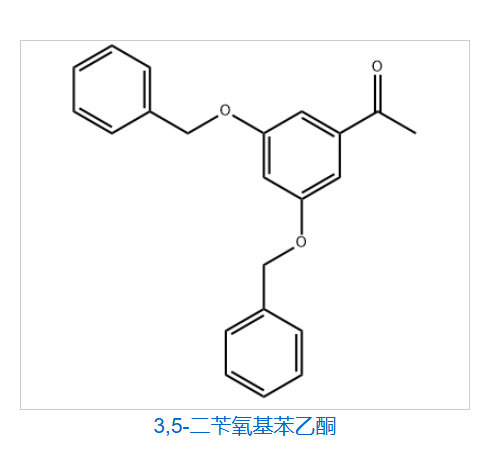
3,5-二苄氧基苯乙酮化学性质熔点:60-62°C(lit.)沸点:429.52°C(roughestimate)密度:1.1079(roughestimate)折射率:1.6000(estimate)储存条件:Sealedindry,RoomTemperature溶解度:Solubleindichloromethane,ethylacetateandmChemicalbookethanol形态:Solid颜色:Off-WhitetoPaleYellowInChIKey:KOJXGMJOTRYLBD-UHFFFAOYSA-NCAS数据库:28924-21-2(CASDataBaseReference)EPA化学物质信息:Ethanone,1-[3,5-bis(phenylmethoxy)phenyl]-(28924-21-2)
*The following content is generated by AI and is for reference only.
3,5-Dibenzyloxyacetophenone is a specialized organic intermediate widely utilized in the fields of pharmaceutical chemistry and material science. With the molecular formula C22H20O3 and a CAS Registry Number of 1004-97-5, this compound serves as a crucial building block for the synthesis of complex heterocyclic structures and bioactive molecules. Its chemical structure features an acetophenone core substituted with two benzyloxy groups at the meta positions, providing unique reactivity profiles essential for advanced synthetic pathways.
In medicinal research, this molecule acts as a key precursor for developing novel therapeutics targeting various diseases. The presence of the acetyl group allows for versatile functionalization through condensation reactions, while the benzyloxy moieties can be selectively removed via hydrogenolysis to reveal hydroxyl groups, enabling the construction of polyphenolic scaffolds common in drug discovery. These structural characteristics make it particularly valuable in the production of kinase inhibitors, anti-inflammatory agents, and potential anticancer compounds. Furthermore, its stability under standard laboratory conditions facilitates ease of handling and storage during multi-step synthesis processes.
Beyond pharmaceutical applications, 3,5-Dibenzyloxyacetophenone finds utility in the development of functional materials, including liquid crystals and optical sensors, where specific electronic properties are required. The aromatic rings contribute to conjugation systems that influence light absorption and emission characteristics. Researchers often employ this compound in methodological studies to optimize reaction conditions for ether cleavage and carbon-carbon bond formation. As demand grows for high-purity intermediates in custom chemical manufacturing, this substance remains a staple in catalogs of fine chemical suppliers. Its role extends to academic research, serving as a model substrate for investigating regioselective substitution patterns and mechanistic studies in organic transformation. Overall, 3,5-Dibenzyloxyacetophenone represents a versatile tool bridging fundamental organic chemistry with practical industrial applications, supporting innovation across multiple scientific disciplines through its robust chemical architecture and adaptable reactivity.


![6,8-Dioxo-5,7-diazaspiro[3.4]octane-2-carboxylic acid](https://eimg.pharmasources.com/image/product/20250403/02effeb5a7639bc84ff1f3add3c0c64fjpg)
![8-Oxa-1,3-diazaspiro[4.5]decane-2,4-dione](https://eimg.pharmasources.com/image/product/20250403/60fa7223d5a34f24138486ceea0ffb15jpg)
![8,16-Diazadispiro[6.1.6.2]heptadecan-17-one](https://eimg.pharmasources.com/image/product/20250403/ca91cba8b87e53fc879f8d8764873a40jpg)



 (All Rights Reserved)