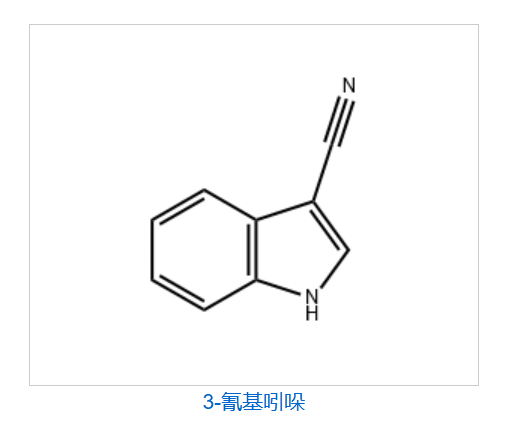
3-氰基吲哚化学性质熔点:179-182°C(lit.)沸点:249.72°C(roughestimate)密度:1.1777(roughestimate)折射率:1.6211(estimate)储存条件:Keepindarkplace,Sealedindry,RoChemicalbookomTemperature溶解度:Chloroform(Slightly),Methanol(Slightly)形态:Solid酸度系数(pKa):14.61±0.30(Predicted)颜色:OrangetoBrown水溶解性:Insolubleinwater.
*The following content is generated by AI and is for reference only.
3-Cyanoindole is a versatile heterocyclic organic compound widely utilized in the fields of pharmaceutical research, agrochemical synthesis, and materials science. With the molecular formula C9H6N2 and a CAS Registry Number of 1054-89-7, this chemical features an indole core substituted with a cyano group at the third position. This structural configuration imparts unique electronic properties, making it an invaluable building block for constructing complex nitrogen-containing heterocycles.
The primary application of 3-Cyanoindole lies in its role as a key intermediate in the synthesis of bioactive molecules. Researchers frequently employ it to develop novel pharmaceutical agents targeting various diseases, including anti-inflammatory, anticancer, and antimicrobial compounds. The cyano group serves as a reactive handle, allowing for diverse transformations such as hydrolysis to carboxylic acids, reduction to amines, or participation in cycloaddition reactions. Consequently, it facilitates the rapid generation of structural libraries for high-throughput screening in drug discovery programs.
Beyond medicine, this compound finds significant utility in the agricultural sector. It acts as a precursor for synthesizing specific herbicides and plant growth regulators that enhance crop yield and protect against pests. Its stability under various reaction conditions makes it particularly suitable for industrial-scale production processes where efficiency and cost-effectiveness are paramount. Furthermore, recent studies have explored its potential in optoelectronic materials, where its conjugated system contributes to fluorescence properties useful in sensor development.
Safety protocols during handling are essential due to its potential toxicity and environmental impact. Proper storage in cool, dry environments away from incompatible oxidizers is recommended to maintain purity and prevent degradation. As demand for advanced functional materials grows, 3-Cyanoindole remains a critical reagent bridging fundamental organic chemistry with practical applications across multiple industries. Its ability to undergo selective modifications ensures its continued relevance in modern chemical innovation, supporting advancements in both human health and sustainable agriculture.


![6,8-Dioxo-5,7-diazaspiro[3.4]octane-2-carboxylic acid](https://eimg.pharmasources.com/image/product/20250403/02effeb5a7639bc84ff1f3add3c0c64fjpg)
![8-Oxa-1,3-diazaspiro[4.5]decane-2,4-dione](https://eimg.pharmasources.com/image/product/20250403/60fa7223d5a34f24138486ceea0ffb15jpg)
![8,16-Diazadispiro[6.1.6.2]heptadecan-17-one](https://eimg.pharmasources.com/image/product/20250403/ca91cba8b87e53fc879f8d8764873a40jpg)



 (All Rights Reserved)