Product Description
Application: Used as Ensitrelvir (S-217622) Intermediates. We can provide CDMO services for COVID-19 drugs with sufficient capacity. Contact us at sales@huatengusa.com now.
Ensitrelvir (code name S-217622) is an oral antiviral drug, which acts as an orally active 3C-like protease inhibitor for the treatment of COVID-19 infection. It has demonstrated antiviral effectiveness against Delta variant and the recently emerged Omicron variant.
AI Product Description
*The following content is generated by AI and is for reference only.
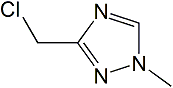
3-(Chloromethyl)-1-methyl-1H-1,2,4-triazole is a specialized organic heterocyclic compound widely utilized in the fields of medicinal chemistry and agrochemical synthesis. With the molecular formula C5H7ClN4 and a CAS registry number of 109368-66-1, this substance features a triazole ring substituted with both a methyl group at the nitrogen position and a reactive chloromethyl group at the carbon position. This unique structural arrangement endows the molecule with significant electrophilic character, making it an invaluable building block for constructing more complex heterocyclic systems.
The primary application of 3-(Chloromethyl)-1-methyl-1,2,4-triazole lies in its role as a key intermediate in pharmaceutical research. Chemists frequently employ this reagent to synthesize novel derivatives possessing potent biological activities, including antifungal, antibacterial, and anticancer properties. The chloromethyl moiety serves as a versatile handle for nucleophilic substitution reactions, allowing for the facile attachment of various amine, thiol, or alcohol functionalities. This versatility facilitates the rapid generation of diverse libraries of compounds during drug discovery campaigns aimed at targeting specific enzymes or receptors.
Beyond the pharmaceutical sector, this compound finds utility in the development of advanced agrochemicals. It is used to create new fungicides and herbicides that offer improved efficacy and environmental profiles compared to older generations of crop protection agents. The 1,2,4-triazole core is known for its stability and ability to interact with biological systems, while the chloromethyl substituent allows for fine-tuning of lipophilicity and metabolic stability.
In laboratory settings, 3-(Chloromethyl)-1-methyl-1H-1,2,4-triazole is handled with standard safety precautions due to its potential irritant properties and lachrymatory nature. It is typically stored in cool, dry environments away from moisture and strong bases to prevent premature hydrolysis or decomposition. As a high-purity synthetic intermediate, it supports the continuous innovation required in modern chemical manufacturing, bridging the gap between basic heterocyclic chemistry and practical therapeutic or agricultural solutions. Its availability enables researchers to accelerate the optimization of lead compounds toward clinical trials or commercialization.





 (All Rights Reserved)






![8-Oxa-1,3-diazaspiro[4.5]decane-2,4-dione](https://eimg.pharmasources.com/image/product/20250403/60fa7223d5a34f24138486ceea0ffb15jpg)
![6,8-Dioxo-5,7-diazaspiro[3.4]octane-2-carboxylic acid](https://eimg.pharmasources.com/image/product/20250403/02effeb5a7639bc84ff1f3add3c0c64fjpg)
![8,16-Diazadispiro[6.1.6.2]heptadecan-17-one](https://eimg.pharmasources.com/image/product/20250403/ca91cba8b87e53fc879f8d8764873a40jpg)
