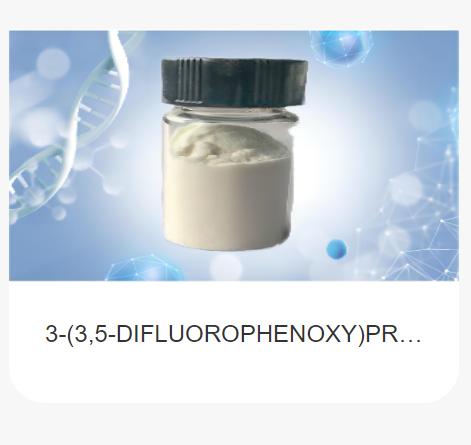
CAS号:844648-16-4英文名:3-(3,5-difluorophenoxy)propanenitrile英文别名:3-(3,5-difluorophenoxy)propanenitrile中文名:Chemicalbook3-(3,5-DIFLUOROPHENOXY)PROPANENITRILE,CBNumber:CB33745884分子式:C9H7F2NO分子量:183.1547864
*The following content is generated by AI and is for reference only.
3-(3,5-difluorophenoxy)propanenitrile is a specialized organic intermediate widely utilized in the pharmaceutical and agrochemical industries. With the molecular formula C10H7F2NO and CAS Registry Number 86493-45-6, this compound features a nitrile group attached to a propyl chain linked via an ether bond to a 3,5-difluorophenyl ring. The presence of two fluorine atoms at the meta positions significantly enhances its lipophilicity and metabolic stability, making it a valuable building block for synthesizing complex bioactive molecules.
In drug discovery, this chemical serves as a critical precursor for constructing heterocyclic scaffolds found in various therapeutic agents. It is frequently employed in the synthesis of kinase inhibitors, which are essential for treating cancers and inflammatory diseases. The trifluoromethyl-like electronic effect provided by the difluoro substitution often improves the binding affinity of the final drug candidate to its target protein. Furthermore, the nitrile functionality offers versatile reactivity, allowing chemists to convert it into amides, amines, or carboxylic acids through standard reduction or hydrolysis protocols, thereby expanding the structural diversity of potential lead compounds.
Beyond pharmaceutical applications, 3-(3,5-difluorophenoxy)propanenitrile finds utility in the development of novel agrochemicals, including herbicides and fungicides designed to combat resistant crop pests. Its specific molecular architecture contributes to enhanced biological activity while maintaining favorable environmental degradation profiles. Manufacturers typically supply this reagent as a high-purity liquid or solid, depending on storage conditions, adhering to strict quality control standards to ensure consistency in large-scale synthesis. Handling requires standard laboratory safety precautions due to potential toxicity associated with nitriles and halogenated aromatics. Researchers must consult Material Safety Data Sheets (MSDS) before use, ensuring proper ventilation and personal protective equipment. As a key enabler in modern medicinal chemistry, this compound continues to support the efficient production of next-generation therapeutics and agricultural solutions, bridging the gap between fundamental organic synthesis and practical industrial application. Its unique combination of structural features makes it indispensable for chemists aiming to optimize pharmacokinetic properties in new drug candidates.


![8-Oxa-1,3-diazaspiro[4.5]decane-2,4-dione](https://eimg.pharmasources.com/image/product/20250403/60fa7223d5a34f24138486ceea0ffb15jpg)
![8,16-Diazadispiro[6.1.6.2]heptadecan-17-one](https://eimg.pharmasources.com/image/product/20250403/ca91cba8b87e53fc879f8d8764873a40jpg)
![6,8-Dioxo-5,7-diazaspiro[3.4]octane-2-carboxylic acid](https://eimg.pharmasources.com/image/product/20250403/02effeb5a7639bc84ff1f3add3c0c64fjpg)



 (All Rights Reserved)