Product Description
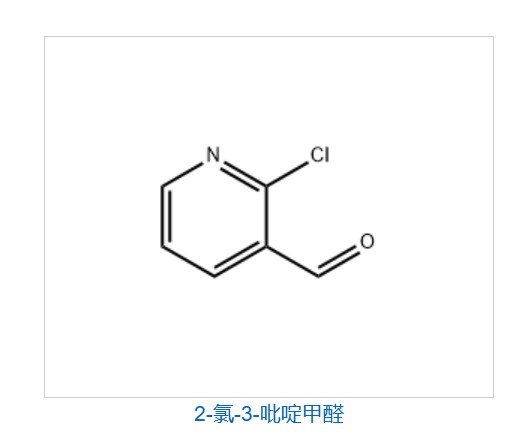
2-氯-3-吡啶甲醛化学性质熔点:50-54°C(lit.)沸点:119°C(Press:30Torr)密度:1.332±0.06g/cm3(Predicted)闪点:>230°C储存条件:KeepindarkplChemicalbookace,Sealedindry,RoomTemperature溶解度:Chloroform,DMSO形态:PowderorLowMeltingSolid酸度系数(pKa):-1.36±0.10(Predicted)
AI Product Description
*The following content is generated by AI and is for reference only.
2-Chloro-3-pyridinecarboxaldehyde is a versatile heterocyclic intermediate widely utilized in the pharmaceutical and agrochemical industries for the synthesis of complex organic molecules. With the molecular formula C6H4ClNO and a CAS registry number of 18790-56-4, this compound features a pyridine ring substituted with both a chlorine atom at the second position and an aldehyde group at the third position. This specific substitution pattern imparts unique reactivity, making it an essential building block for constructing bioactive compounds containing nitrogen-containing heterocycles.
The primary application of 2-chloro-3-pyridinecarboxaldehyde lies in medicinal chemistry, where it serves as a key precursor for developing novel drugs targeting various diseases. The aldehyde functionality allows for diverse transformations, including condensation reactions to form imines, oximes, and Schiff bases, while the chloro substituent offers a site for nucleophilic aromatic substitution or cross-coupling reactions such as Suzuki-Miyaura or Buchwald-Hartwig couplings. These chemical properties enable researchers to introduce a wide array of functional groups, facilitating the creation of potent inhibitors, kinase modulators, and antimicrobial agents. In the agricultural sector, this molecule is similarly employed in the development of new herbicides and fungicides, contributing to improved crop protection strategies.
Physically, 2-chloro-3-pyridinecarboxaldehyde typically appears as a yellow to orange crystalline solid or viscous liquid, depending on purity and temperature conditions. It exhibits moderate solubility in common organic solvents like ethanol, dichloromethane, and dimethyl sulfoxide but remains largely insoluble in water. Due to its reactive nature, proper storage under inert atmospheres and low temperatures is recommended to prevent degradation or polymerization. Safety data indicates that the compound should be handled with standard laboratory precautions, wearing appropriate personal protective equipment to avoid skin contact or inhalation, as aldehydes can be irritants. Overall, its structural versatility and availability make 2-chloro-3-pyridinecarboxaldehyde a valuable asset in modern organic synthesis, driving innovation in drug discovery and materials science.


![6,8-Dioxo-5,7-diazaspiro[3.4]octane-2-carboxylic acid](https://eimg.pharmasources.com/image/product/20250403/02effeb5a7639bc84ff1f3add3c0c64fjpg)
![8-Oxa-1,3-diazaspiro[4.5]decane-2,4-dione](https://eimg.pharmasources.com/image/product/20250403/60fa7223d5a34f24138486ceea0ffb15jpg)
![8,16-Diazadispiro[6.1.6.2]heptadecan-17-one](https://eimg.pharmasources.com/image/product/20250403/ca91cba8b87e53fc879f8d8764873a40jpg)



 (All Rights Reserved)