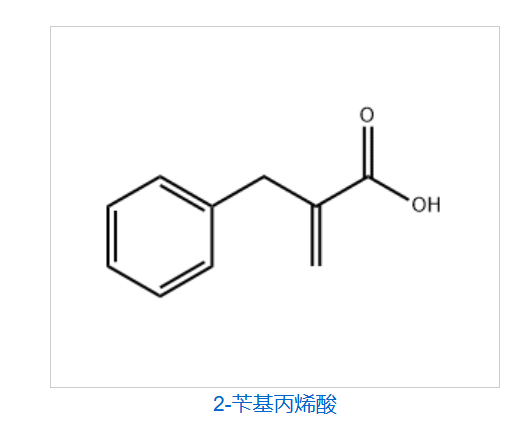
2-苄基丙烯酸化学性质熔点:66-68°C沸点:170-174°C(Press:20Torr)密度:1.120储存条件:Keepindarkplace,Sealedindry,RoomTemperature溶解度:Chloroform(Slightly),Methanol(Slightly)形态:Solid酸度系数(pKa):4.48±0.11(Predicted)颜色:WhitetoOff-WhiChemicalbookte稳定性:LightSensitiveInChI:InChI=1S/C10H10O2/c1-8(10(11)12)7-9-5-3-2-4-6-9/h2-6H,1,7H2,(H,11,12)InChIKey:RYNDYESLUKWOEE-UHFFFAOYSA-NSMILES:C(C1C=CC=CC=1)C(=C)C(=O)OCAS数据库:5669-19-2(CASDataBaseReference)
*The following content is generated by AI and is for reference only.
2-Benzylacrylic acid, chemically known as 3-phenylbut-2-enoic acid with the molecular formula C10H10O2 and CAS Registry Number 6841-59-2, is a versatile organic compound widely utilized in advanced chemical synthesis and pharmaceutical research. This unsaturated carboxylic acid features a conjugated system linking a phenyl ring to an acrylic acid backbone via a methylene bridge, imparting unique reactivity profiles essential for modern organic transformations. Its primary application lies in the synthesis of complex heterocyclic compounds, particularly within the development of non-steroidal anti-inflammatory drugs (NSAIDs) and various bioactive molecules where structural complexity is paramount.
In industrial chemistry, 2-benzylacrylic acid serves as a crucial intermediate for producing high-performance polymers and functional materials. The presence of the double bond allows for facile radical polymerization or Michael addition reactions, enabling the creation of specialized resins with tailored thermal and mechanical properties. Furthermore, researchers frequently employ this molecule as a building block in multi-step synthetic pathways to access chiral derivatives through asymmetric catalysis, which is increasingly vital in the production of enantiopure pharmaceutical agents.
The compound exhibits moderate solubility in common organic solvents such as ethanol, dichloromethane, and ethyl acetate, while remaining sparingly soluble in water. This solubility profile facilitates its handling in both laboratory-scale experiments and large-scale manufacturing processes. Safety protocols dictate that it should be handled with standard precautions due to potential skin and eye irritation, though it does not possess extreme toxicity under normal handling conditions. Storage recommendations include keeping the material in a cool, dry place away from strong oxidizing agents to prevent premature polymerization or degradation.
As the demand for novel therapeutic agents and advanced materials grows, the role of 2-benzylacrylic acid remains significant in the global chemical supply chain. Its ability to act as a scaffold for diverse chemical modifications ensures its continued relevance in academic research and commercial applications alike. Manufacturers prioritize high purity grades to meet stringent regulatory requirements in the pharmaceutical industry, ensuring consistent performance in critical synthesis steps. Overall, this compound represents a key link between fundamental organic chemistry and practical industrial innovation.


![6,8-Dioxo-5,7-diazaspiro[3.4]octane-2-carboxylic acid](https://eimg.pharmasources.com/image/product/20250403/02effeb5a7639bc84ff1f3add3c0c64fjpg)
![8,16-Diazadispiro[6.1.6.2]heptadecan-17-one](https://eimg.pharmasources.com/image/product/20250403/ca91cba8b87e53fc879f8d8764873a40jpg)
![8-Oxa-1,3-diazaspiro[4.5]decane-2,4-dione](https://eimg.pharmasources.com/image/product/20250403/60fa7223d5a34f24138486ceea0ffb15jpg)



 (All Rights Reserved)