Product Description
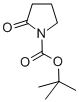
Application: 1-(tert-butoxycarbonyl)-2-pyrrolidinone, CAS NO.85909-08-6 is a useful synthetic intermediate. It can be used as larotrectinib intermediates. It can also be used to prepare highly functionalized N-acyl-2-vinylpyrrolidines by a 4-component Ugi reaction (isocyanide, carbonyl compounds, primary amines, carboxylic acids). It can also be used to synthesize the naturally occurring Maillard flavors via catalytic SeO2 oxidation.
AI Product Description
*The following content is generated by AI and is for reference only.
1-Pyrrolidinecarboxylic acid, 2-oxo-, 1,1-dimethylethyl ester, commonly known as Boc-proline or N-Boc-L-proline (depending on stereochemistry), is a vital building block in modern organic synthesis and pharmaceutical development. Its chemical structure features a pyrrolidine ring substituted with a ketone group at the C2 position and protected by a tert-butyloxycarbonyl (Boc) group on the nitrogen atom. The molecular formula for this compound is C9H15NO3, and it is identified by the CAS number 2487-36-3 for the L-isomer, though specific stereoisomers may have distinct identifiers. The primary function of this molecule lies in its role as a protected amino acid derivative used extensively in peptide chemistry.
In laboratory and industrial settings, Boc-proline serves as an essential reagent for solid-phase peptide synthesis (SPPS). The bulky tert-butyl group attached to the carbamate moiety provides robust protection for the amine functionality during chain elongation, preventing unwanted side reactions such as racemization or self-polymerization. This stability allows chemists to selectively couple proline residues into complex peptide sequences under mild conditions. Furthermore, the Boc group can be easily removed using acidic reagents like trifluoroacetic acid (TFA) without affecting other sensitive functional groups, making it highly versatile for multi-step synthetic routes.
Beyond standard peptide assembly, this compound finds applications in the synthesis of bioactive molecules, including potential drug candidates targeting neurological disorders, cardiovascular diseases, and metabolic syndromes. Proline derivatives are particularly valuable due to their unique cyclic structure, which imparts conformational rigidity to peptides, often enhancing biological activity and metabolic stability. As a result, Boc-proline is widely stocked by chemical suppliers for research institutions, academic laboratories, and pharmaceutical manufacturers. Its high purity grades ensure reproducibility in critical experiments. Whether utilized in medicinal chemistry campaigns or fundamental structural biology studies, 1-pyrrolidinecarboxylic acid, 2-oxo-, 1,1-dimethylethyl ester remains a cornerstone reagent for constructing sophisticated nitrogen-containing heterocycles and biologically relevant macrocycles.





 (All Rights Reserved)

![8-Oxa-1,3-diazaspiro[4.5]decane-2,4-dione](https://eimg.pharmasources.com/image/product/20250403/60fa7223d5a34f24138486ceea0ffb15jpg)
![8,16-Diazadispiro[6.1.6.2]heptadecan-17-one](https://eimg.pharmasources.com/image/product/20250403/ca91cba8b87e53fc879f8d8764873a40jpg)
![6,8-Dioxo-5,7-diazaspiro[3.4]octane-2-carboxylic acid](https://eimg.pharmasources.com/image/product/20250403/02effeb5a7639bc84ff1f3add3c0c64fjpg)