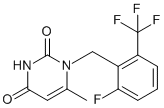
Huateng Pharmaceutical, a global supplier of pharmaceutical intermediates, offers Elagolix intermediates 1-(2-Fluoro-6-trifluoromethyl-benzyl)-6-methyl-1H- pyrimidine-2,4-dione (CAS No.: 830346-47-9) for your requirements of R&D, evaluation, pilots and commercial along with supportive technical package required for evaluation.
*The following content is generated by AI and is for reference only.
1-(2-Fluoro-6-trifluoromethylbenzyl)-6-methyl-1H-pyrimidine-2,4-dione is a sophisticated organic heterocyclic compound characterized by its unique structural arrangement of a pyrimidine dione core substituted with a fluorinated benzyl group and a methyl moiety. Its molecular formula is C13H9F4N2O2, reflecting the presence of four fluorine atoms which significantly influence its lipophilicity and metabolic stability. While specific CAS registry numbers for this exact derivative may vary depending on synthesis routes or commercial catalog listings, it generally falls under the broader category of halogenated uracil derivatives widely utilized in medicinal chemistry research.
This compound serves as a critical intermediate and scaffold in the discovery and development of novel pharmaceutical agents. The incorporation of the 2-fluoro-6-trifluoromethylbenzyl group is particularly strategic; such perfluorinated motifs are frequently employed to enhance membrane permeability, inhibit metabolic degradation by cytochrome P450 enzymes, and improve binding affinity within biological targets. Researchers often explore derivatives like this for potential applications in oncology, antiviral therapy, and central nervous system disorders. The pyrimidine-2,4-dione ring system itself is a privileged structure known for its ability to interact with various enzyme active sites, including kinases and nucleoside transporters.
In laboratory settings, this molecule is primarily used as a building block for synthesizing more complex bioactive libraries. Its distinct physicochemical properties allow chemists to fine-tune the pharmacokinetic profiles of drug candidates during lead optimization phases. Furthermore, studies involving fluorinated heterocycles contribute valuable data regarding structure-activity relationships (SAR), aiding in the rational design of next-generation therapeutics with improved selectivity and reduced toxicity. Although not yet a widely marketed commercial drug, its chemical architecture represents a promising avenue for advancing modern drug discovery programs focused on targeting difficult-to-drug proteins. Continued investigation into this class of compounds holds significant potential for unlocking new treatment modalities against resistant pathogens and malignant diseases, making it a subject of enduring interest in academic and industrial research communities alike.





 (All Rights Reserved)



![8-Oxa-1,3-diazaspiro[4.5]decane-2,4-dione](https://eimg.pharmasources.com/image/product/20250403/60fa7223d5a34f24138486ceea0ffb15jpg)
![6,8-Dioxo-5,7-diazaspiro[3.4]octane-2-carboxylic acid](https://eimg.pharmasources.com/image/product/20250403/02effeb5a7639bc84ff1f3add3c0c64fjpg)

![8,16-Diazadispiro[6.1.6.2]heptadecan-17-one](https://eimg.pharmasources.com/image/product/20250403/ca91cba8b87e53fc879f8d8764873a40jpg)


