
Targeted therapies have played an increasingly important role in tumor treatment in recent years. I’d like to introduce in detail an "upstart"—CDK 4/6 inhibitors in the breast cancer therapeutic area today. Pfizer’s palbociclib, Novartis’ ribociclib, and Eli Lilly’s abemaciclib have been approved for marketing and formed a situation of tripartite confrontation, wherein, the global sales of Pfizer’s palbociclib accounted for 89% of the CDK 4/6 inhibitor market in 2018 upon its first-mover advantage, however, the annual growth of palbociclib has gradually declined in recent years, and many enterprises have laid out the area. Therefore, it is still unknown as to whether which will dominate the CDK 4/6 inhibitor market in the future.

What are CDK 4/6 inhibitors?
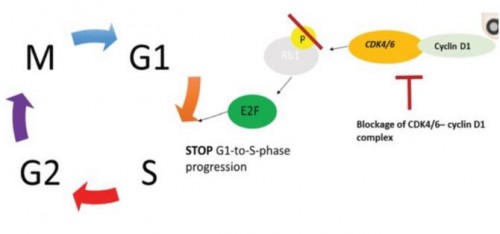
CDK, i.e., cyclin-dependent kinase, plays an important role in cell cycle control, wherein, CDK 4/6 can phosphorylate retinoblastoma (Rb) by binding to cyclin D, to release the transcription factor E2F to promote transcription of the cell cycle-related gene and make cells enter the S phase. According to research, in ER+ breast cancer, CDK 4/6 overactivity is very frequent, and CDK 4/6 is a key downstream target of ER signal. According to preclinical data, the dual inhibition of CDK 4/6 and ER signal has a synergy and can inhibit the growth of ER+ breast cancer cells in the G1 phase.
It is well known that unlimited proliferation and cell cycle deregulation are basic characteristics of tumors. Not only can CDK 4/6 inhibitors effectively block tumor cells from progressing from G1 phase to S phase, they can also inhibit the growth of G1-phase ER+ breast cancer cells, restore cell cycle control, and block tumor cell proliferation. On the other hand, the potential mechanism of action of CDK 4/6 inhibitors can also delay or overcome endocrine resistance and enhance the efficacy of endocrine therapy, which stands for the special advantages of CDK 4/6 inhibitors over other targeted drugs.
CDK 4/6 inhibitors, the "upstart" in the breast cancer therapeutic area in recent years, are rapidly changing the treatment patterns of HR+/HER2- advanced breast cancer; they can effectively overcome or delay the occurrence of endocrine resistance to strive for more survival time for advanced patients.
Pfizer’s palbociclib accounts for more than half of the market shares among the three CDK 4/6 inhibitors
Three CDK 4/6 inhibitors have been approved by the FDA for marketing, separately Pfizer’s palbociclib, Novartis’ ribociclib, and Eli Lilly’s abemaciclib.
As the first CDK 4/6 inhibitor approved by the FDA, palbociclib received the FDA’s accelerated approval in Feb. 2015 based on a Phase II study (PALOMA-1) to be used in combination with letrozole as a first-line therapy for postmenopausal ER+/HER2- advanced breast cancer. The application for expanding the indication of palbociclib—postmenopausal HR+/HER2- advanced breast cancer in patients who have failed the endocrine therapy in combination with fulvestrant was approved by the FDA in Feb. 2016 based on a randomized controlled Phase III study (PALOMA-3). Based on the results of a Phase III study: MONALEESA-2, ribociclib was approved by the FDA in Mar. 2017 as a first-line therapy for HR+ / HER2- advanced breast cancer in postmenopausal women. Abemaciclib, the third CDK 4/6 inhibitor approved, was approved to be used in combination with an aromatase inhibitor (AI) as a first-line therapy for postmenopausal HR+/HER2- advanced or metastatic breast cancer in Feb. 2018 based on the results of the MONARCH-3 study. And abemaciclib is the first and only CDK 4/6 inhibitor that can significantly prolong the lives of premenopausal/perimenopausal/postmenopausal patients in combination with fulvestrant. (See the following figure for the relevant clinical study information mentioned above.)
























 (All Rights Reserved)