
The world is full of wonders. According to an article published by a British doctor in the British Journal of Haematology two days ago, a malignant lymphoma patient’s tumor almost disappeared after infection with coronavirus! It was a 61-year-old man with severe kidney disease and requiring long-term dialysis treatment to sustain life; not long ago, he was hospitalized for treatment of lymphadenopathy and weight loss and was found to have advanced Hodgkin lymphoma, with PET/CT examination showing active cancer cells everywhere in his body (the black areas in the figure on the left below represent the ones taken over by tumor cells).
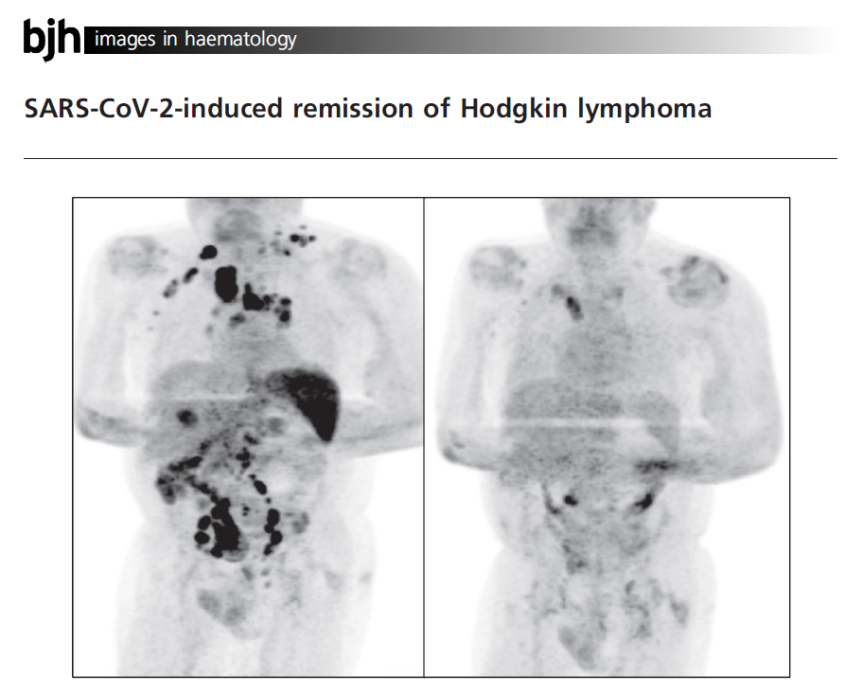
Changes in Tumor Foci Before and After Infection with Coronavirus (Source: Reference 1)
To add insult to injury, he was hospitalized again for breathlessness shortly after diagnosis, and this time he was diagnosed with COVID-19. His symptoms remitted 11 days after hospitalization, and he was discharged to convalesce at home. No corticosteroid or immunochemotherapy was administered during the period.
Miraculously, four months later, the PET/CT reexamination revealed that most of the tumor in his body disappeared (see the figure on the right above, where the black areas disappear) and the levels of tumor-related biomarkers dropped by more than 90%. What happened? Researchers currently have no clear conclusions as to this phenomenon, and the mainstream hypothesis is that the coronavirus infection accidentally triggered an anti-tumor immune response in the patient’s body, which not only killed the virus but also destroyed the cancer cells in the process.
This phenomenon is not an isolated case, and there were cases of patients with other cancers whose tumors disappeared after they were infected with viruses in history. As a result, researchers have developed a new therapy for tumors based on the phenomenon – oncolytic viruses. Let’s look at it today.
Immunotherapy that “kills cancer with the virus”
Oncolytic viruses (OVs) are a type of viruses selectively infecting and killing tumor cells, with a specific replication ability and the ability to stimulate the body to produce an anti-tumor immune response. OV therapy refers to the use of viral self-replication in infected cancer cells to destroy the host cells, i.e., the use of the original direct cell-killing efficacy of viruses to achieve treatment goals.
By hijacking the protein synthesis “factories” of tumor cells, OVs prevent cells from producing host products and promote cells to produce viral products, which may also be due to the essence of viral virulence; infected host cells undergo lysis to release many viruses with the ability to infect other cells, thus amplifying and spreading the initial infection. However, OVs do not replicate themselves within normal cells, therefore, normal cells are not harmed thereby.
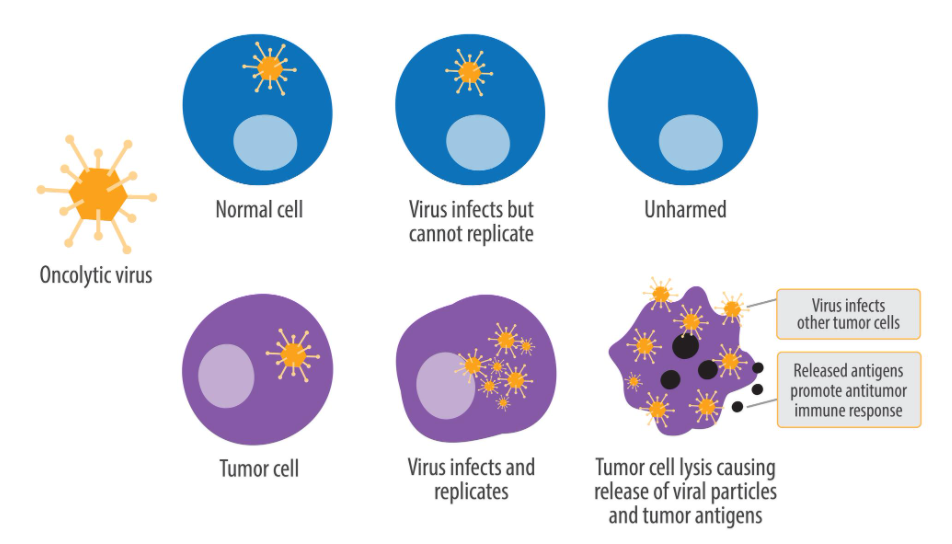
OV Specifically Killing Tumor Cells (Source: Wikipedia)
The world’s first OV was reported because a cervical cancer patient’s tumor regressed after she was infected with the rabies virus. Scientists have made significant progress in OV research in recent years. OVs, as a kind of emerging anti-tumor therapeutic agents, have the advantages of high efficiency in killing tumor cells, good targeting, high safety, small side effects and low cost. OV therapy has been classified as an important branch of tumor immunotherapy as OVs can promote the triggering of the anti-tumor specific immune response in patients while infecting and killing cancer cells.
OVs play a central role in OV therapy. Dozens of viruses have been used for OV therapy to date, including herpes simplex virus type 1 (HSV-1), adenovirus, reovirus, Newcas...




























 (All Rights Reserved)