
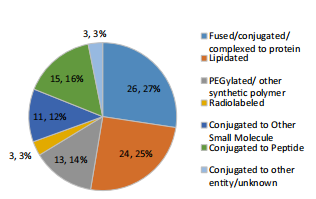
Conjugation has emerged as a popular mechanism to alter or enhance the properties of peptide and protein drug candidates. The proportion of conjugated peptides and the variety of conjugated moieties has increased over time; 30% of peptides that entered clinical development since the start of 2010 are conjugates.
Conjugation to polyethylene glycol (PEG), lipids, and proteins such as Fc fragments has been used as a half-life extension strategy, with the first such peptides entering clinical development in the late-1990s. Conjugation can also be used to deliver a cytotoxic payload or imaging agent to specifific cell types targeted by the peptide. See Table below for a description of various conjugation strategies deployed with therapeutic peptide development
candidates.



























 (All Rights Reserved)