
Inhalation formulations are a dosage form with high technical barriers, with relatively few pharmaceutical enterprises entering this field at the beginning. More enterprises have started to make overall plan of inhalation formulations or entering this field by breaking through key varieties, with the worsening of environmental pollution and the increase of respiratory diseases in China.

Inhalation formulations are a drug dosage form where the drug is dissolved or dispersed in a suitable medium, directly enters the respiratory tract in the form of vapor or aerosol via a specific drug delivery device and is then delivered to the lungs to produce local or systemic therapeutic effects. They rapidly and directly improve the efficacy, with the adverse drug reactions reduced while the dosage is reduced, and have become the preferred therapeutic drugs for bronchial asthma, chronic obstructive pulmonary disease (COPD), and other respiratory diseases and also commonly used in the otorhinolaryngology department, surgery (inhalation anesthetics), and cardiology department.
In terms of different devices used, inhalation formulations are generally divided into MDI (metered-dose inhaler), DPI (dry powder inhaler), nebulizer solution (NEB), and inhalation spray, etc. This article focuses on the development and competition situation of inhalation formulations in the Chinese market taking the inhalation formulations of the respiratory system as an example.
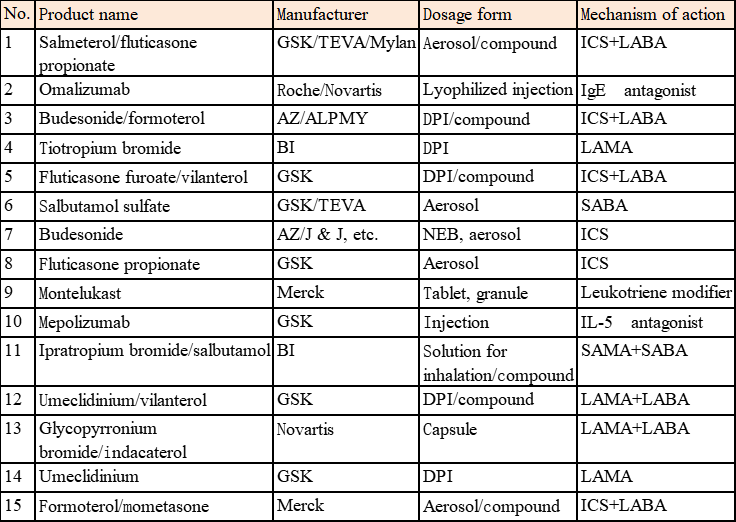
Respiratory diseases are the second most common diseases in China, second only to cardiovascular and cerebrovascular diseases. Respiratory diseases are divided into acute and chronic respiratory diseases; wherein, chronic respiratory diseases include asthma and COPD, etc., accounting for 1/3 of the total, being the third major common chronic diseases after diabetes and cardiovascular diseases, and chronic respiratory diseases are also the third leading cause of death in China and need to be taken very seriously. Global respiratory disease medications are chemical inhalation preparations, the dosage forms are mainly aerosols and powder aerosols, with the drugs mainly used including ICS (budesonide and fluticasone, etc.) and bronchodilators (represented by salmeterol, formoterol, salbutamol, and tiotropium bromide) and compound formulations, etc. (see Table 2 for the details).
See Table 1 for the specific classification:
Table 1 Classification of Common Respiratory System Drugs
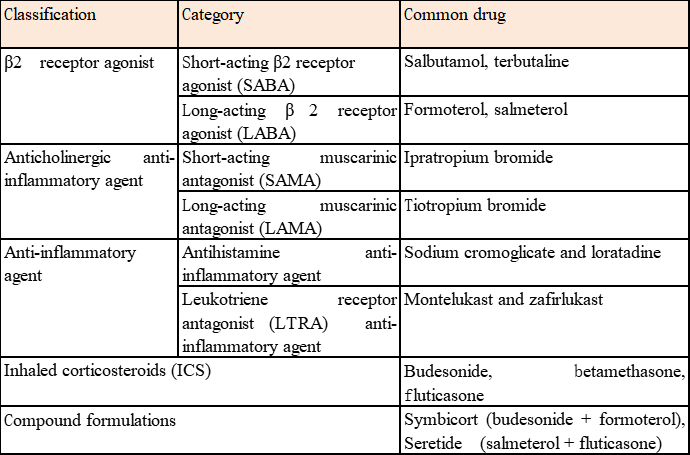
Table 2 Main Varieties of Global Respiratory System Drugs
Technical barriers to inhalation formulations
1. R&D barriers: Inhalation formulations are a combination of multiple technologies such as pharmacology, inhalation kinetics, particle dynamics, fluid mechanics, surface science and inhaler design and processing, etc., with very high R&D difficulties. Most inhalation formulations are also special formulations combining drugs and devices, with high requirements for drug-device linkage. As a result, appropriate inhalation devices are the core of R&D, and drug-device combination methods need to be sufficiently reasonable; furthermore, from the perspectives of process and prescription, particle size, dispersion state of the raw and auxiliary materials, ratio and combination method with the carrier, and moi...




























 (All Rights Reserved)