

Logo of Zhejiang Biosan Biotech. Co., Ltd.
Macrofungi with nutritive value and medicinal value are collectively called edible and medicinal fungi, and commonly known as mushrooms. The medicinal value and health efficacy of edible and medicinal fungi have become increasingly known to consumers and a large number of health foods and dietary supplements produced with extracts of edible and medicinal fungi as the raw material has come to the market, especially, Reishi (Ganoderma lucidum), Cordyceps sinensis, Inonotus obliquus, Grifola frondosa, and Hericium erinaceus, etc., in recent years as scientists’ research on the active ingredients and functions of edible and medicinal fungi gradually increases. As the market demands increase, the edible and medicinal fungus extract industry rapidly develops, however, the quality of extract products of edible and medicinal fungi varies greatly on the market as beset by raw material quality, processing technology, and detection means, etc., and the cheap low-quality products seriously affect the industry development. How to produce and identify high-quality extracts of edible and medicinal fungi has become a focus of the industry. As a high-tech enterprise focusing on R&D, production, and sales of high-quality edible and medicinal fungus products, Zhejiang Biosan Biotech. Co., Ltd. has accumulated valuable experience in production and detection of high-quality extracts of edible and medicinal fungi.
Making good products with good raw materials
The quality of raw edible and medicinal fungi determines the quality of the final extract products. The cultivation environment, culture media, and cultivation method of edible and medicinal fungi have large impacts on the raw material quality. Some varieties of edible and medicinal fungi, such as Agaricus subrufescens, enrich heavy metals, and have strict requirements for soil and water, etc., therefore, it is crucial to select the cultivation environment and culture media without ecological pollution. The cultivation base shall be relatively isolated from farmland, and pesticide shall not be used during the cultivation, to avoid excessive pesticide residues of the edible and medicinal fungi. For wood-decay fungi like Reishi, it is better to use basswood cultivation, as the active ingredient content of the edible and medicinal fungi produced is higher than that produced through substitute cultivation. The active ingredient content of different parts of edible and medicinal fungi varies, and parts with low active ingredient content such as stipe shall often be removed during the extraction. Quality of the raw edible and medicinal fungi used for extraction shall be strictly controlled. Besides the routine physical and chemical testing, it is essential to detect the metal content and pesticide residue thereof.
Zhejiang Biosan Company has established cultivation demonstration bases of organic edible and medicinal fungi such as Reishi, mushroom, Grifola frondosa, Hericium erinaceus, and Tremella fuciformis in Zhejiang Longquan, Qingyuan, and Fujian Gutian, etc. according to European and American organic standards, and successively passed the organic certification of the U.S., EU, and China. Those bases have beautiful environment, fresh air, and clear water, are quite suitable for the growth of edible and medicinal fungi, and are origin of mushrooms, with long history in mushroom planting.
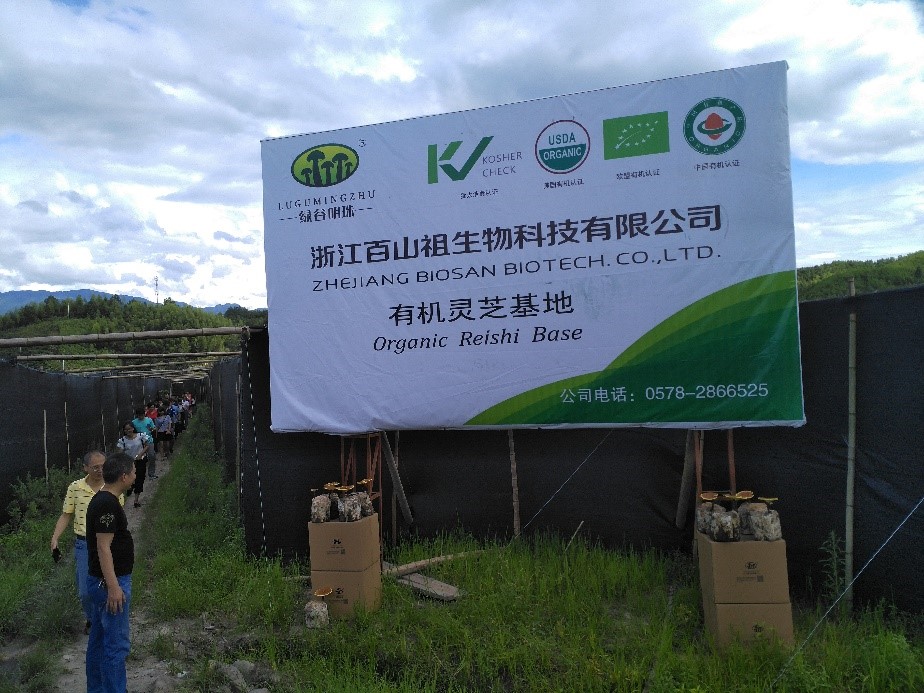

The Organic Reishi Base in Longquan, Zhejiang, the “Home of Ganoderma Lucidum”
Processing good products with new process
The main active ingredient of extracts of edible and medicinal fungi is fungal polysaccharides (β-glucan), and water is generally used as the extraction solvent; ed...

























 (All Rights Reserved)