

Stability testing is the process of analysing and monitoring the active pharmaceutical ingredients/APIs or the final pharmaceutical products/FPPs stability over time to ensure that it stays safe and effective during its shelf life and under that labelled storage conditions. The various guidelines including the stability testing for the new drug substance and products is provided in the ICH Q1 A-F and guidelines including the stability testing for the biotechnological/biological products is provided in ICH Q5C. A stability programme is a thorough plan for assessing and monitoring the long-term stability of a medicinal product that is under the post-marketing/ Phase IV of the clinical trials. Its purpose is to ensure that the medication product remains safe and effective throughout its proposed shelf life with storage condition. [1]
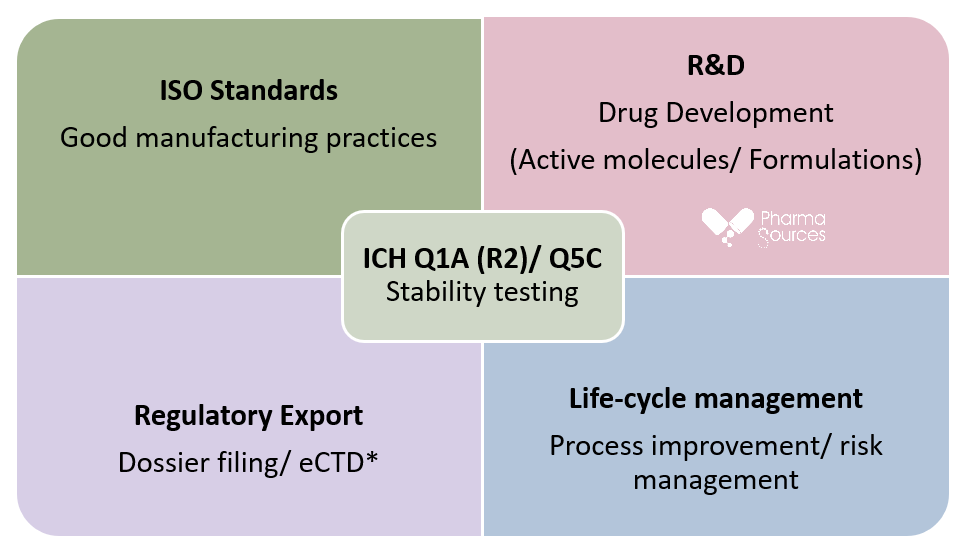
Figure above represents a matrix chart with stability testing shown in the centre as it plays a crucial part with supporting the pharmaceutical industry’s research and development R&D and manufacturing units in the drug development, process improvement and risk management, also it is vital for dossier filing and compliance with GMP. * eCTD full form is electronic common technical data, it consists of 5 modules out of which stability report is essential part in the module 2.
The stability of an API is frequently greater than that of the FPP. This is due to the fact that the API is often a pure and active product, but the FPP comprises additional substances such as excipients, added flavours as per the drug manufacturing formula DMF and packaging materials such as foils/containers. These additional substances may interact with the API, affecting its stability. Excipients, for example, can absorb moisture or oxygen, which can damage the API. Packaging materials can also interact with the API by leaching chemicals into the product, for example. Furthermore, the FPP is often subjected to greater environmental pressures than the API. During storage, shipping, and dispensing, for example, the FPP may be exposed to light, heat, and humidity. These pressures can potentially hasten the deterioration of the API. As a result of these elements, the FPP appears to have shorter shelf life than the API.
Stability testing as per the ICH Q1 A (R2) is applicable to new drug substance and products while ICH Q5C has the stability testing guidelines for the biotechnological/biological products. Stability studies are a critical component of the medication development and manufacturing processes. They help to ensure drug quality, safety, and efficacy, and they are necessary for drug export to other nations. Stability summary report or stability batch report is crucial document for dossier filing with the drug regulatory bodies hence it is very essential to work hard on the stability programme along with considering the methods for cost reduction since stability testing are stretched to a long term and frequent testing studies. [2]
The protocol for a drug substance's stability study is generally comparable to the protocol for a final pharmaceutical product's stability study. Yet there exists some differences like in the storage conditions and analytical methods. The analytical procedures used in drug substance stability studies are often more complex than those used in final pharmaceutical product stability studies. This is due to the fact that drug ingredients decay faster than finished pharmaceutical products, and the breakdown products may be more difficult to identify. Protocol for the FPP stability study includes:
Product details: The protocol should include the final pharmaceutical product's strength, formulation, and packaging.Read More


































 (All Rights Reserved)