

Over the previous 50 years, pharmaceutical production unit has been using the batch manufacturing concept because of its low setup cost and flexibility. The next batch cannot begin until the previous batch has been done and this process does requires human intervention that is prone to error. Today the batch manufacturing is losing momentum. The world is moving towards automation therefore the change that is being adopted by the manufacturers of drugs is the approach of continuous manufacturing (CM) whereby the material input and output happens simultaneously and throughout. This implies that there won't be any breaks or human intervention in-between the continuous manufacturing process. Apart from the pharmaceutical industry, this process been more prevalent in food/beverage industries as well as chemical industries. This concept of CM was first introduced in the early 19th century by Oliver Evans who developed a continuous flour mill based on this concept. By 1990, The US Food and Drug Administration (FDA) begins to encourage the development and adoption of continuous manufacturing in the pharmaceutical industry. [1]
CM has become the norm, however, pharmaceutical continuous production is still gaining ground. For the treatment of cystic fibrosis, Vertex's Orkambi (lumacaftor/ivacaftor) received the first approval using CM in 2015. The first medication that the FDA permitted to convert from batch manufacturing to continuous manufacture (CM) was Janssen's Prezista (darunavir), used to treat HIV. Six CM-based treatments for diseases such leukaemia, cystic fibrosis, HIV-1 infections, and breast cancer had received FDA approval by the beginning of 2019. The government authorised three applications using CM processes in 2020, including the first regulatory application using CM for API and the first continuous biomanufacturing process, according to Center for Drug Evaluation and Research CDER's 2020 Annual Quality Report. [2]
When compared to batch manufacturing, CM got more benefits, such as:
Increased productivity and efficiency: As there is no downtime between batches and need for human interventions time to time, hence continuous manufacturing can result in significant increase in productivity as well as efficiency.
Cost savings: Continuous production can save costs by eliminating waste and maximising resource efficiency. Nevertheless the technology involved in CM is costly but it will reduce the overall cost of expenditure when compared to batch manufacturing in the long run.
Quality by Design: Product quality can be enhanced with the concept of quality by design (QbD) in CM, which gives manufacturers more control over the production process.
Reduced environmental impact: By consuming less trash and energy, continuous manufacturing can help to lessen the environmental impact of manufacturing and is considered as sustainable production than batch manufacturing.
There are different mode of CM, details regarding this is provided in the ICH Q13 guideline for implementation of CM in the already existing pharmaceutical set up or setting up for new pharmaceutical and bio manufacturing units.
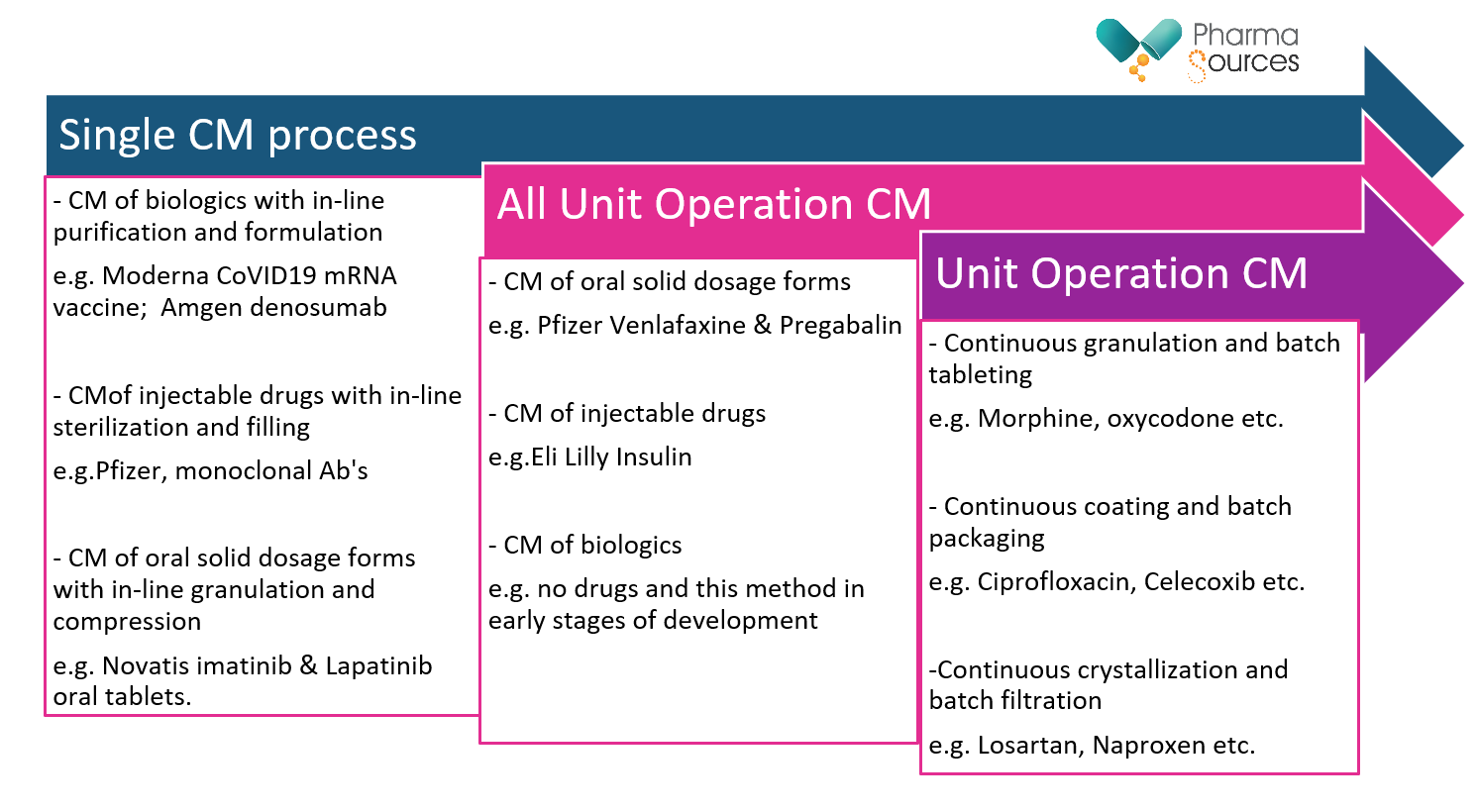
Figure above is showing the three mode of CM as per the ICH Q13 guidelines including different processes with examples of the products that are been manufactured.
The key points of the requirements for changing the manufacturing mode of a drug from batch to continuous are:
1. The considerations listed in Section 3 of the ICH Q13 Guideline ICH Q5E on Continuous Manufacturing of Drug Substances and Drug Products must be taken into consideration when developing a new control strategy for the continuous manufacturing process.
2. ...


































 (All Rights Reserved)