
According to my analysis of medical insurance data in the previous article, China’s national medical insurance has become an important guarantee of pharmaceutical product sales.
The negotiation process for AstraZeneca’s oral hypoglycemic drug dapagliflozin flooded WeChat Moments, with the price negotiated from RMB5.62, to RMB4.72, to RMB4.62, to RMB4.50, to RMB4.40, and eventually to RMB4.36. "Price reduction" is still a key to the success of the NRDL negotiations in 2019.
The National Medical Products Administration of China (NMPA) has been vigorously implementing reform and issued many hallmark policies since 2017, such as the policies for consistency evaluation, priority review, overseas new drugs catering to clinical urgent needs, list of rare diseases, establishment of the National Healthcare Security Administration of China, NRDL negotiations, and centralized procurement. China is opening fast review tracks for the true blockbuster innovative drugs catering to clinical urgent needs, on the one hand, and it is also actively improving patients’ ability to pay, on the other hand.
It is the best of times and it is the worst of times.
This article focuses on the 2019 NRDL negotiations, autoimmune diseases, AIDS, hepatitis C, and rare diseases.
I. Overview of the 2019 NRDL negotiations: 70 new pharmaceutical products, an average price decline of 60.7%
150 in total
According to the CCTV news, the list of 128 alternative pharmaceutical products for negotiation was review and selected by experts by voting, and 119 biological pharma products were determined as the new varieties for negotiation after the relevant enterprises confirmed their intention to negotiate; furthermore, 31 among the varieties listed via negotiations in 2017 needed renegotiating for renewal.
Negotiations for 97 succeeded
The pharmaceutical products for which the negotiations succeeded are mostly those newly marketed in recent years with high clinical values, involving over 10 clinical treatment areas such as cancers, rare diseases, hepatitis, diabetes, multi-drug-resistant tuberculosis, rheumatic autoimmune diseases, cardiovascular and cerebrovascular diseases, and digestive diseases.
From the perspective of key areas, the negotiations for the 5 essential drugs were all successful, and so were the negotiations for the 22 anticancer drugs, 7 rare disease drugs, 14 chronic disease drugs (including diabetes, hepatitis B, and rheumatic arthritis, etc.) and 4 pediatric drugs. Among the varieties for which the negotiations succeeded, 70 varieties are new, and 27 are "renewed".
Price decline by 60.7%
The average price decline of the 70 new pharmaceutical products has reached 60.7% and that of the 27 renewed pharmaceutical products has reached 26.4%, which can reduce the individual burden of patients by more than 80% and the burden from some pharmaceutical products by more than 95%.
Remarks: There were 36 varieties from the negotiated NRDL in 2017 in the negotiations this year (Editor's Note: in 2019), wherein, 5 (ticagrelor, abiraterone, rituximab, bortezomib, and lenalidomide) were not among the 2019 NRDL for negotiations because their generic drugs have been marketed, and the negotiations for 4 (fulvestrant, recombinant human interferon beta-1b, tolvaptan, and lapatinib) failed.
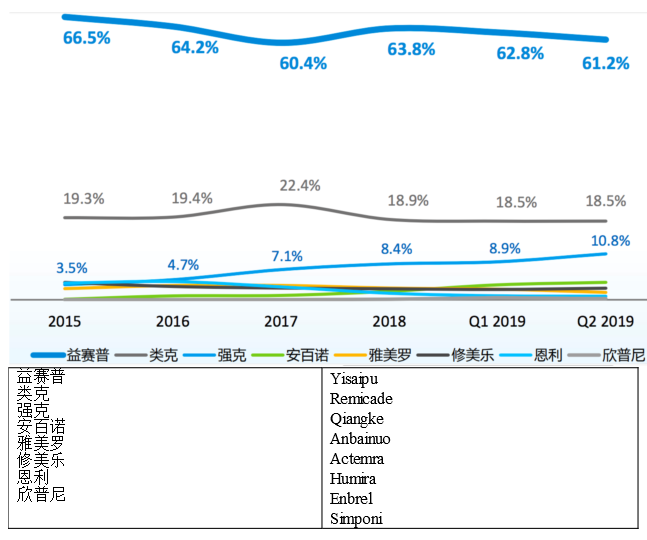
II. Autoimmune diseases: Humira, Remicade, Actemra, and Simponi are all listed
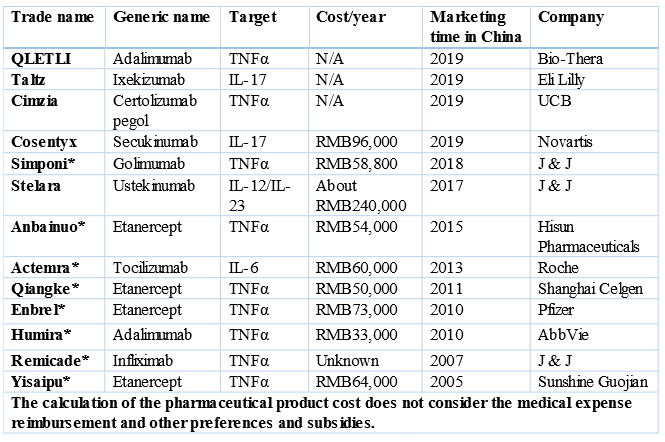
Tocilizumab: Adjusted from RMB1,925.00/piece to RMB830.00/piece, -57%, 60kg, about RMB60,000/year
Humira: Adjusted from RMB7,608.38/piece to RMB3,160/piece, -58%, further -59% in the NRDL negotiations, RMB33,000/year
Enbrel: Adjusted from RMB2,400/piece to RMB699/piece, -70%, RMB73,000/year;

































 (All Rights Reserved)