

1. What is Paracetamol? (1), (4)
Paracetamol belongs to a class of drugs called Aniline Analgesics. It does not belong to the NSAIDs family and it lacks the anti-inflammatory activity.
Other names for Paracetamol are: Acetominophen and Acetyl Para-Amino Phenol, abbreviated as APAP.
The following figure no. 01 illustrates the chemical structure of this compound.
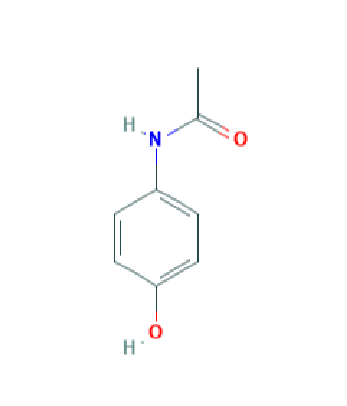
Figure No. 01: Chemical 2D Structure of Paracetamol
IUPAC Name: N-(4-hydroxyphenyl) acetamide
CAS Number: 103-90-2 (1)
This compound is sold worldwide under different trade names, such as:
1. Adol
2. Calpol
3. Pain Relief
4. Panadol
5. Panamax
6. Panda
7. Paramol
8. Perfalgan
9. Revanin
10. Tylenol
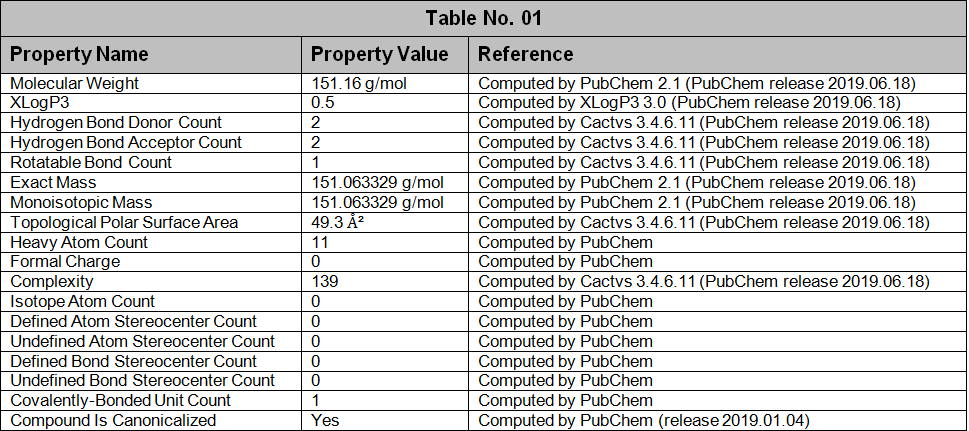
The following table No. 01 summarizes all the chemical characteristics of Paracetamol (1).
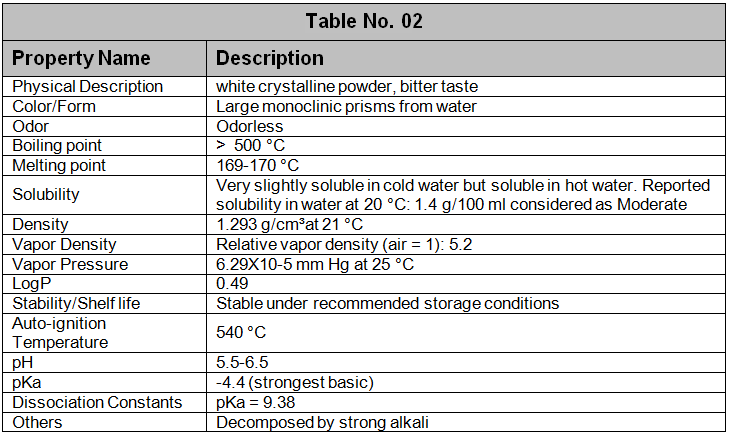
The following table no. 02 summarizes the main physical properties of Paracetamol material (1).
2. What are the specifications of Paracetamol?
For the detailed technical specification of Paracetamol raw material (e.g. physical description, identification, assay, purity, elemental analysis, residuals, related substances, etc…), you can easily search through PharmaSources.Com platform for all relevant suppliers who are going to respond to any of your enquiries. You can either search in the information available in each supplier`s profile, or inquire the relevant Drug Master File (DMF) or Certificate of Analysis (COA) directly for any extra details.
3. How Paracetamol is produced? (1),(4)
3.1. Original (Boots) method:
The original method for production involves the nitration of a phenol ring with sodium nitrate to give a mixture of two isomers. The preferred one which is: 4-nitrophenol that has a boiling point of 279 °C can be easily separated using the steam distillation. After that, the added nitro group will be reduced to an amine, giving the 4-aminophenol. As a last step, the amine group will be acetylated (e.g. using heat and a mixture of acetic anhydride and glacial acetic acid) to give Acetyl Para Amino Phenol (APAP). The following figure no. 02 illustrates this synthetic route.
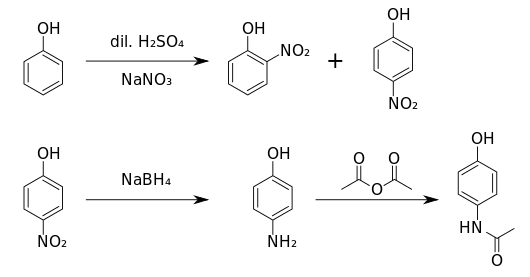
Figure No. 02: The Original (Boot) Method (4)
3.2. Green Synthesis:
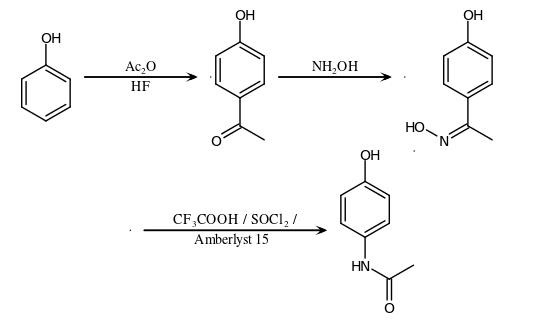
Another method developed by Hoechst–Celanese involves direct acylation of a phenol ring with acetic anhydride catalyzed by HF, followed by subsequent conversion of the ketone group to a ketoxime with hydroxylamine which will be subjected to the acid-catalyzed Beckmann rearrangement to give the amide group. The following figure no. 03 illustrates this route.

























 (All Rights Reserved)