

In powder handling industries, screw feeders are routinely used to control the flow of material from a hopper into the subsequent stage of a process. The accurate and consistent feeding of materials into reaction systems, mixers and other processing equipment is necessary to maintain optimal conditions, and to generate products of the required quality at the required rate.
However, predicting feed rates has historically relied on engineering estimation based on experience and the extrapolation of and pre-existing information on performance – either from pilot scale trials, or from data collected at earlier installations. This can lead to equipment that does not meet the target design requirements, and result in sub-standard operation or, in extreme cases, complete process failure.
In an attempt to more accurately predict the expected feed rate of powder in a given feeding process, one approach is to use statistical, multivariate models to evaluate the relationships between powder behaviour and process performance. However, many studies are hampered by the use of overly simplistic characteristics of the bulk powder, such as angle of repose, or flow through an orifice, which do not necessarily represent the conditions that the powder is subjected to in the feeder. A method of accurately quantifying a powder’s response to process-relevant conditions is required for the development of a robust statistical model.
The FT4 Powder Rheometer® is a universal powder tester that provides automated, reliable and comprehensive measurement of bulk material characteristics. This information can be correlated with process experience to improve processing efficiency and aid quality control. Specialising in the measurement of Dynamic Flow properties, the FT4 also incorporates a Shear Cell, and the ability to measure Bulk properties such as density, compressibility and permeability.
This study demonstrates how to generate a design and operating model based around robust measurements of rheological properties of powders and standard Multiple Linear Regression (MLR) analysis.
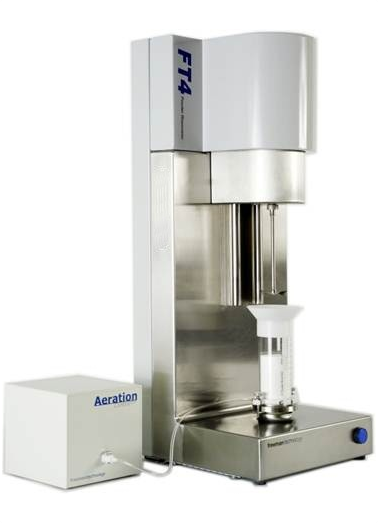
FT4 Powder Rheometer® from Freeman Technology
Quantifying Feeder Performance
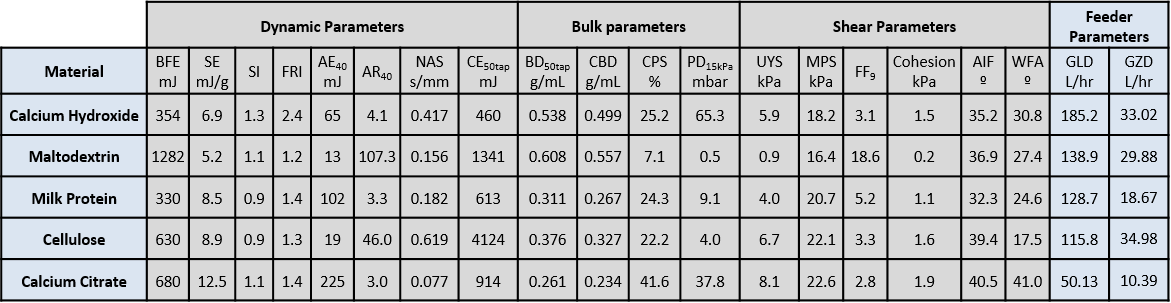
Five powders (Calcium Hydroxide, Maltodextrin, Milk Protein, Cellulose and Calcium Citrate) were run through two different screw feeders to determine the volumetric feed rate (L/hr) delivered at an auger rotation speed equivalent to 80 Hz. The volumetric flow rate (in L/hr) was calculated from measurements of mass flow rate (in kg/hr) and poured density.
The two screw feeders that were used were a DIWE-GLD-87 VR, full flight single-screw feeder using tube No. 3 (Figure 1), and a DIWE-GZD flat bottom double-screw feeder using a 12x13.5mm tube with a conical core (Figure 2) (Gericke AG, Switzerland).
The five materials were also evaluated using an FT4 Powder Rheometer, and MLR was performed to evaluate the relationship between parameters measured by the FT4 and the volumetric feed rate. The resulting model was tested by comparing predicted volumetric feed rate for two additional powders (Lactose and Cement) with the actual rate achieved in the feeders.
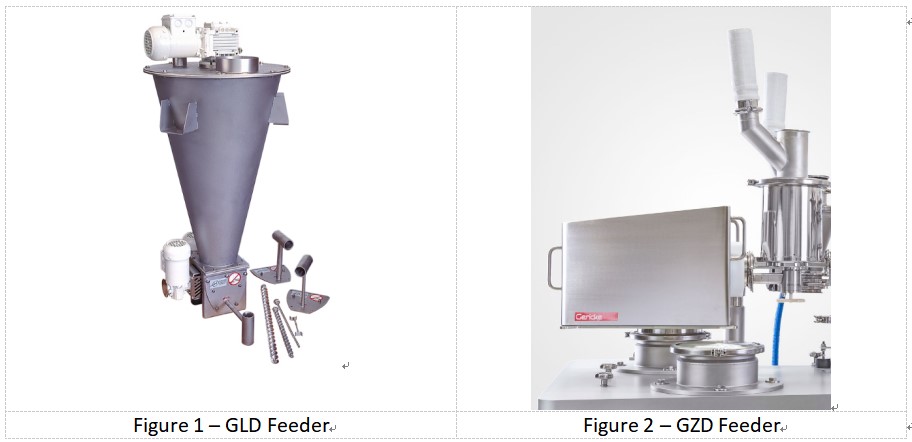
Images courtesy of Gericke AG.
Measured Test Data
Multiple Linear Regression
MLR is a mathematical process that attempts to define a model quantifying a dependent parameter (y) – in this case volumetric feed rate – in terms of influential independent variables – in this case the measured powder properties.
The process generates a p value for each parameter, which indicates...



























 (All Rights Reserved)