

A diverse range of unit operations are employed to process and manipulate powders. These invariably subject materials to a wide range of conditions – from the relatively high and static compaction stresses observed in hoppers, to the low stress, dynamic conditions experienced during fluidisation. A thorough understanding of how a bulk material will behave over a range of conditions, and in various phases of flow – whether stationary, in motion or about to move – is therefore vital for designing and monitoring the unit operations and transfer systems that make up any given process.
Despite the extreme variations that exist between different operations, there is still a tendency to identify a simple, single parameter with which to characterise a powder. Single number characterisation, such as those categorising performance from ‘cohesive’ to ‘free flowing’, is unlikely to be sufficient in fully evaluating and predicting the performance of materials across a range of processes.
The key is to ensure compatibility between processing equipment and the characteristics of the powders it will handle. Such an approach requires a comprehensive understanding of the bulk behaviour of the materials in order to feed relevant information into process design and development from the outset.
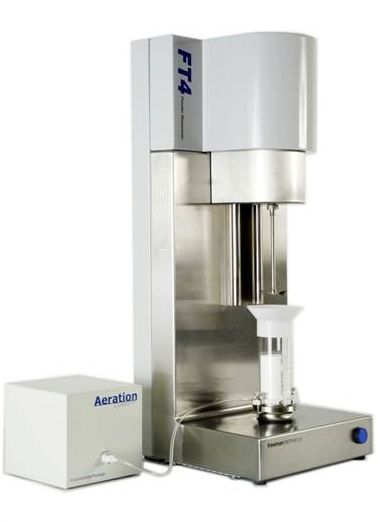
FT4 Powder Rheometer®
The FT4 Powder Rheometer is a universal powder tester that provides automated, reliable and comprehensive measurement of bulk material characteristics. This information can be correlated with process experience to improve processing efficiency and aid quality control. Specialising in the measurement of dynamic flow properties, the FT4 also incorporates a shear cell, and the ability to measure bulk properties such as density, compressibility and permeability, enabling a comprehensive characterisation of a powder in a process relevant context.
During dilute phase pneumatic conveying, powder is transported in a fluidised state using air flow or a vacuum. In this process, there are a number of issues that can be encountered, such as choking, adhesion, or flooding. A powder’s permeability, and response to the presence of air, are therefore both likely to be critical properties. Through appropriate testing it is possible to determine whether a material can reach a fluidised state, and the air flow required to achieve this. Such testing supports the determination of optimal operating parameters.
Sensitivity to air can be quantified using the FT4’s Aeration test. In this test, Flow Energy is measured while air is introduced to the powder bed at increasing velocities. This enables simple and precise identification of when fluidisation occurs, as illustrated by the two examples in Figure 1.
Figure 1: Typical Aeration test result.



























 (All Rights Reserved)