

With advancements in biomedical science, drug discovery has evolved different strategies. However, with this dramatic progress, concerns have emerged regarding the efficiency of translating these technical advances into safe and efficacious new drugs.
The two main strategies for advanced drug discovery are target-based and phenotypic screening strategies. While the target-based approach starts with a hypothesis related to the disease, the phenotypic strategy is the molecular approach, in which genetics and molecular sciences identify a molecular hypothesis.
Phenotypic Drug Discovery – The Unbiased Approach
Phenotypic screening strategies involve assays that measure a clinically meaningful phenotype in a physiologically relevant system such as an animal or cell. Phenotypic screening strategies do not require a prior understanding of the molecular mechanism of action, and drug identification follows an unbiased approach.
The phenotypic screening approach is also called ‘forward pharmacology,’ as the molecular mechanism and protein target can remain unknown even after the drug’s activity and efficacy are determined. A well-known example of a drug discovered by phenotypic screening is aspirin, whose mechanism of action was found almost 100 years after its discovery.
Value of phenotypic screening to drug discovery
The phenotypic screen is usually more physiologically relevant and less artificial because intact cells and native cellular environments are used. In phenotypic screening, a disease characteristic is exploited to develop a cell-based assay. Compounds are then screened in the assay to identify active lead compounds that ameliorate the disease phenotype.
Primary hits identified in the phenotypic screens can target enzymes, receptors, transcription factors, and even different signaling pathways. Lead compounds can be further selected from the hits with or without knowledge of the target. However, identification of the target can facilitate the structure-activity relationship (SAR) study to decode the relationship between the chemical structure of a molecule and its biological activity.
Phenotypic screening enables drug discovery to proceed with incomplete information – the approach allows for identifications of first-in-class medicines and their respective molecular mechanisms of action or ‘pharmacological hot spots.’ The phenotypic screen enables lead discovery for many diseases in which a drug target has not been identified and validated, for example, rare diseases.
Target-based drug discovery – Hypothesis-driven
Target-based approach for drug discovery, also called ‘reverse pharmacology,’ generally starts with target identification of a disease of interest. Increased understanding of the molecular basis of a disease has expanded the utility of a target-based approach. The molecular targets are often discovered in basic research, with studies involving animal disease models and clinical observations of patient phenotypes.
Target-based approaches are often simpler to execute than phenotypic methods, operating with knowledge of a drug’s molecular mechanisms from an earlier stage. Target-based approaches have dominated the pharma industry because of its efficiency, cost economy, and massive throughput.
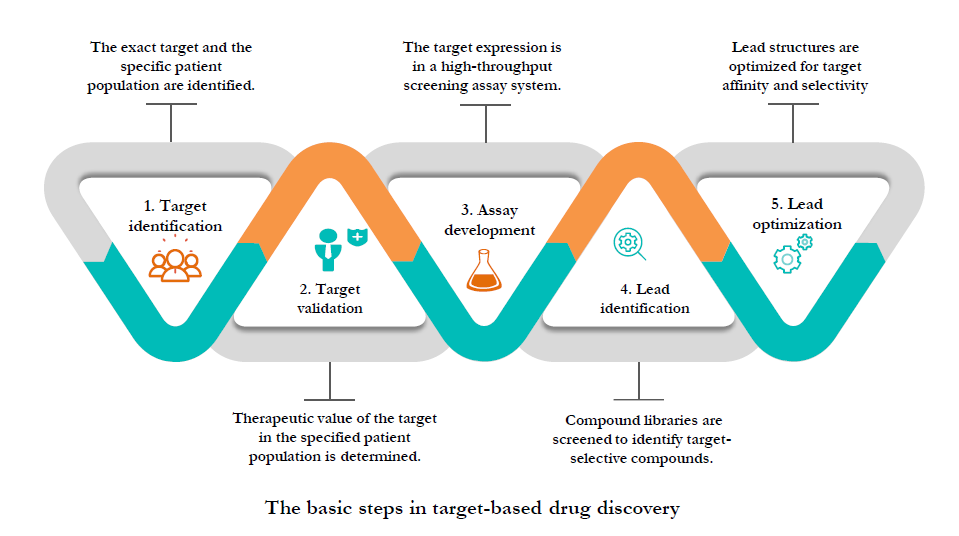
Target-based drug discovery affects only “the target,” i.e., one gene or molecular mechanism to selectively treat the deficit that causes the disease without producing side effects. The basic steps involved in a target-based drug discovery are depicted in the infographic below:
Human genetics - One of the most powerful tools in the identification of drug targets
The discovery of the genetic basis of a disease provides hope that a drug targeting that particular gene or the protein produced by the gene has an excellent probability of succeeding. Certain molecular targets, such as protein kin...


































 (All Rights Reserved)