
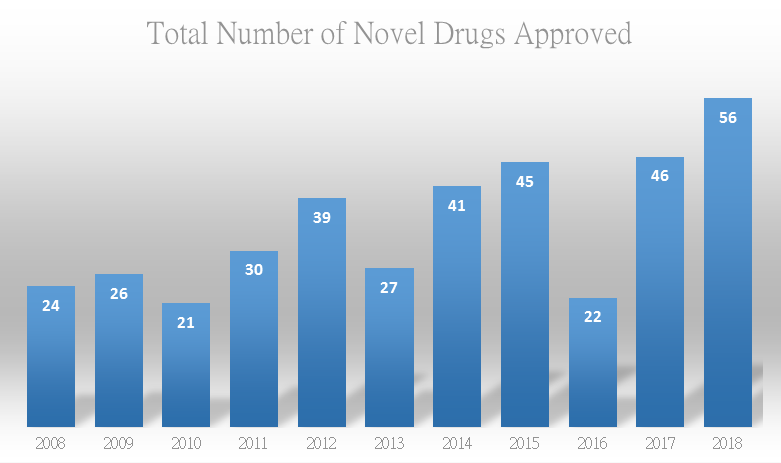
Looking back 2018, FDA has started to implement the real-time review, and implemented strict review of opioids. Among the drugs approved, cannabidiol, lofexidine, 3 anti-CGRP monoclonal antibody (mAb) drugs, the first RNAi drug, and small molecule broad-spectrum anticancer drug, etc. are especially impressive; rare disease Lambert-Eaton myasthenic syndrome, hereditary angioedema, Dravet syndrome, and Fabry disease, etc. usher in innovative therapies; FDA approved the world’s 6th anti-PD-(L)1 mAb, and HIV cocktail therapy and antibody drugs obtain breakthrough progress, etc.
Looking back 2018, the marketing of many drugs is of great significance. Here, I’d like to review several of them for your discussion and reference.
I. Migraine antibody drugs: 3 anti-CGRP mAbs approved for marketing
Anti-CGRP mAbs are a variety of drugs with quite definite mechanism of action. Amgen/Novartis, Teva, and Eli Lilly have successively marketed 3 anti-CGRP mAbs in 2018, showing breakthrough progress of migraine drugs. The 3 drugs enjoy positive market expectations, and are injected subcutaneously and priced at $6,900/year. However, the medication regimen of Teva’s drug is more flexible: it can be used by month/quarter. According to the forecast of Evaluate Pharma, the anti-CGRP drug market can reach USD5 billion in 2024. Refer to the article Global CGRP Drug Market Expected to Reach USD5 Billion by 2024, with 4 Anti-CGRP Antibodies Ranking Top 4 of the Market for the details.
Wherein, Aimovig (erenumab) of Novartis/Amgen was the first approved for marketing and became the first in class, which is one of the most noteworthy review developments in 2018; sooner or later, the drug will grow into a blockbuster drug as it could bring significant clinical benefits to migraine patients. According to the data of NCT02066415 clinical trial, compared to the placebo, the drug could reduce the monthly attacks of chronic migraine patients further by 2.5 attacks.
This area still merits attention in 2019, with the focuses mainly on: 1. The antibody drug eptinezumab developed by Alder will be approved for marketing to become the 4th anti-CGRP antibody; 2. The small molecule anti-CGRP drug: Ubrogepant developed by Allergan will also be filed the marketing application, to hopefully become the first small molecule anti-CGRP drug approved for marketing.
II. The small molecule broad-spectrum anticancer drug: Vitrakvi to continue to expand the pan-cancer therapy
In 2017, keytruda received an indication of concern, i.e., MSI-H/dMMR solid tumors. Its regimen to prevent and treat multiple cancers "in a basket" became a much concerned focal topic, and the "Basket Trial" gained extensive attention.
Loxo Oncology continued its legend on Nov. 26, 2018: Vitrakvi (larotrectinib) was approved for advanced solid tumors harboring an NTRK gene fusion, making larotrectinib (LOXO-101), a legendary molecule that shone in 2017 ASCO, attract the world’s attention again. The clinical data showed that the drug reached ORR of 78% among 55 patients with salivary gland cancer, carcinosarcoma, infantile fibrosarcoma, lung cancer, or thyroid cancer, etc.
Vitrakvi, despite a very small market, will make "precision medicine" and "broad-spectrum anticancer" more deeply into people’s minds and the intensive and more precise patient stratification become clearer in the future as a small molecule broad-spectrum anticancer drug.
III. The world’s 6th anti-PD-(L) 1 antibody: Libtayo® accelerated the marketing
There have been 6 anti-PD-(L)...

PharmaSources July 14, 2025























 (All Rights Reserved)