
Peptides are a class of compounds composed of multiple amino acids linked by peptide bonds. They are ubiquitous in organisms. Up to now, tens of thousands of peptides have been found in organisms. Peptides play an important role in regulating the functional activities of various systems, organs, tissues and cells of the body, as well as in life activities, and are often used in functional analysis, antibody research and drug research and development. With the development of biotechnology and peptide synthesis technology, more and more peptide drugs have been developed and applied in clinic.
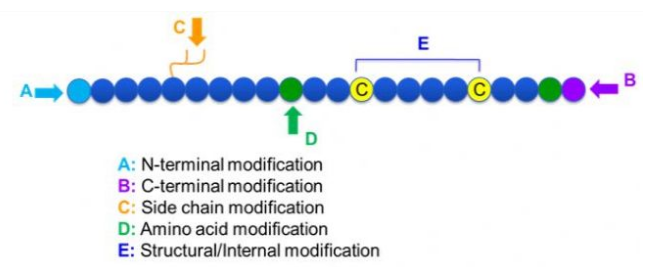
There are many kinds of peptide modification, which can be divided into post modification and process modification (using derivatized amino acid modification). According to different modification sites, it can be divided into N-terminal modification, C-terminal modification, side chain modification, amino acid modification, skeleton modification, etc. (Fig. 1). As an important method to modify the main chain structure or side chain group of peptide chain, peptide modification can effectively change the physical and chemical properties of peptide compounds, increase water solubility, prolong the action time in vivo, modify their biological dispersion, eliminate immunogenicity, and reduce toxic reactions. The main characteristics and the main modifications of peptides are introduced in this paper.
1. Cyclization
Cyclic peptides have many applications in biomedicine, and many bioactive natural peptides are cyclic peptides. Because cyclic peptides are often more rigid than linear peptides, they have strong resistance to the digestive system, can survive in the digestive tract, and show stronger affinity to target receptors. Cyclization is the most direct way to synthesize cyclic polypeptides, especially for peptides with large skeleton. According to the cyclization mode, it can be divided into side chain side chain type, terminal side chain type and terminal terminal terminal type (head and tail connected type).
(1) Side chain to side chain
The most common type of side chain side chain cyclization is disulfide bridge between cysteine residues. The method of introducing this cyclization is to form disulfide bond by oxidation of a pair of cysteine residues. By selectively removing the sulfhydryl maintenance group, the synthesis of polycyclic compounds can be completed. Cyclization can be accomplished in both the solvent after dissociation and the resin before dissociation. Because the polypeptides on the resin are not easy to form a cyclizable conformation, cyclization on resin may be less efficient than cyclization in solvent. Another variant of side chain side chain cyclization is to form amide structure between aspartic acid or glutamic acid residues and root amino acids, which requires that the side chain maintenance groups of polypeptides must be selectively removed either on the resin or after dissociation. The third side chain side chain cyclization is the formation of diphenyl ethers via tyrosine or p-hydroxyphenylglycine. The cyclization of this species in natural products is only found in microbial products, and the cyclization products often have potential pharmaceutical value. The preparation of these compounds requires common reaction conditions, so they are not often used in the synthesis of conventional peptides.
(2) Terminal to side chain
Terminal side chain cyclization usually involves the C-terminal amino group of lysine or ornithine side chain, or the N-terminal with aspartic acid or glutamic acid side chain. In addition, some polypeptides are cyclized by ether bonds formed by terminal C and serine or threonine side chains.
(3) Head to tail
The chain peptide can be cyclized in solvent or fixed on the resin through side chain cyclization. Low concentrations of polypeptides should be used for cyclization in solvents to prevent oligomerization of peptides. The yield of cyclic polypeptides is dependent on the sequence of chain polypeptides. Therefore, we should first create a possible chain like lead peptide library ...



























 (All Rights Reserved)