
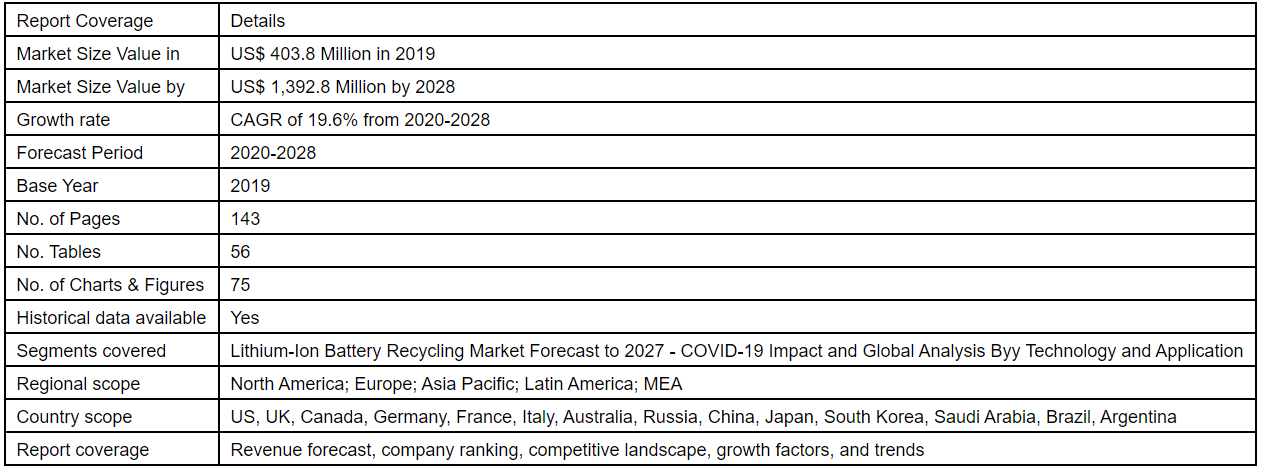
According to The Insight Partners study on "Lithium-Ion Battery Recycling Market Forecast to 2028 – COVID-19 Impact and Global Analysis – by Battery Chemistry, Application, and Geography," the market is projected to reach US$ 1,392.8 million by 2028 from US$ 423.6 million in 2021; it is expected to register a CAGR of 19.6% during 2021–2028.
Lithium-ion batteries are becoming crucial and are found in large proportion among industries including automotive, mining, and consumer electronics. Smartphones, cordless power tools, laptops, tablets, and grid-energy storage, and electric vehicles are the prominent applications where lithium-ion batteries are commonly used. Companies such as Tesla and Envirostream are taking necessary steps to promote lithium-ion battery markets. In November 2020, Lithium Australia's subsidiary—Envirostream—signed an agreement with SungEel HiTech, a South Korean firm, to supply metals to manufacture recyclable batteries. Envirostream provides energy metals, such as nickel, lithium, and cobalt, extracted from recycled lithium-ion batteries to SungEel HiTech. These minerals are used to deliver environmentally sustainable technology projects. Similarly, Tesla to boasts largest lithium-ion battery at the Hornsdale site in South Australia. This project will contribute to improving the energy sector.
Factors such as improper disposal of lithium-ion battery, recovery of valuable metals through disposal of lithium-ion batteries, and government initiatives for lithium-ion battery recycling are contributing toward the market growth. The increasing use of electric vehicles to lower carbon emission and comply with stringent government mandates is another aspect contributing toward the lithium-ion battery recycling market growth.
Several countries worldwide have declared a state of emergency as COVID-19 continues to spread. Besides the urgent "cities closure" in European, American, and Asian countries, key manufacturing industries in India, Malaysia, Philippines, and other Southeast Asian nations have announced closures in succession, which is expected to bring challenges to the supply side of several industries such as automotive, marine, industrial, and electric and electronics. The long-term impact of COVID-19 is still unknown. However, the shutdown of the critical material supply chain has negatively impacted the battery manufacturing industry. The declining prices of oil have attracted several consumers to buy gasoline-powered automobiles. Also, fluctuating shifts, tariffs, economic and environmental policies, and prolonged trade conflicts between the US and China had disrupted raw material supply chains and shifted a few manufacturing and recycling facilities to Europe and Japan. Yet, the electric energy storage demand stays high for personal electronics and cars, as well as renewable energy efforts rely on available battery banks in their primary aim to decarbonize the energy supply, distribute it, and make it more inexpensive. Thus, the COVID-19 pandemic is anticipated to have a short-term negative impact on the lithium-ion battery recycling market.
Download the Latest COVID-19 Analysis on Lithium-Ion Battery Recycling Market Growth Research Report at https://www.theinsightpartners.com/covid-analysis-sample/TIPRE00009267/
Government Initiatives for Lithium-Ion Battery Recycling to Propel its Market Growth in Coming Years
Several governments across the world are taking initiatives to find innovative ways of lithium-ion battery recycling. In 2017, the UK government announced to spend ~US$ 315 million for supporting the development of new battery technologies over the next four years through Faraday Challenge for battery research. Under this, the University of Birmingham seeks innovative ways to recycle lithium-ion batteries. The US Department of Energy (DoE) has also taken initiatives to support the recycling of lithium-ion batteries. The DoE has announced the "Lith...


























 (All Rights Reserved)