
Parkinson’s disease (PD) is the second most common neurodegenerative disease after Alzheimer's disease, which affects about 1% population in the world. PD patients may continue to increase as society develops and the aging of the population becomes increasingly severe.

PD is mainly treated by drugs, however, those drugs can only alleviate the symptoms but cannot stop the disease progression and normally have big side effects. For example, safinamide approved in 2017 is the first anti-PD new drug approved in recent decades, and its adverse reactions include uncontrolled involuntary movement, falls, nausea, and insomnia, etc. Therefore, a new drug is urgently needed clinically.
The team of Professor Yue Zhenyu at Icahn School of Medicine at Mount Sinai has recently discovered that Vitamin B12 could have the effect of treating PD and the research has been published in Cell Research online on Mar. 11.
Vitamin B12
Vitamin B12, also known as cobalamin or cyanocobalamin, is the only vitamin that contains a metallic element and has been so far one of the latest discovered B-group vitamins. It is a B-group vitamin constituted by a cobalt-bearing porphyrin, which was separated from the liver in 1948, determined its structural formula in 1963, and completed artificial synthesis in 1973. Woodward won the Nobel Prize in Chemistry for the outstanding contribution to the organic synthesis thereof in 1965.
Mainly existing in meat, B12 is also contained in soybeans and some herbs, and it can be synthesized by intestinal bacteria, therefore, B12 is generally not lacking, however, B12 is a vitamin easily deficient in patients with digestive tract disease and is also an important element essential for erythropoiesis. If B12 is seriously deficient, it will cause pernicious anemia.

Pathogenesis of PD
PD is a neurodegenerative disease of the central nervous system with a high incidence among the elderly population. The medical community considers the cause of PD to be the functional decline and number decrease of dopaminergic neurons in the nigrostriatal area of the central nervous system, which causes hyposecretion of the excitatory neurotransmitter dopamine, however, the cause and pathogenesis of the neurodegenerative disease of PD are still not completely clear.
LRRK2 has been so far identified as the single gene with the greatest relevance with PD and was not discovered by researchers until 2004. At first, researchers held that the most common LRRK2 missense mutation would cause hyperactivity of LRRK2 protein kinase, which is associated with the attack of PD.
Later, the importance of LRRK2 in PD has been gradually discovered. Researchers have found that LRRK2 plays a pivotal role in PD development regardless of whether it mutates or not. Idiopathic PD patients without mutation also have LRRK2 protein hyperactivity and impaired autophagy function of neurons, which causes the abnormal accumulation of alpha-synuclein to participate in PD progression!
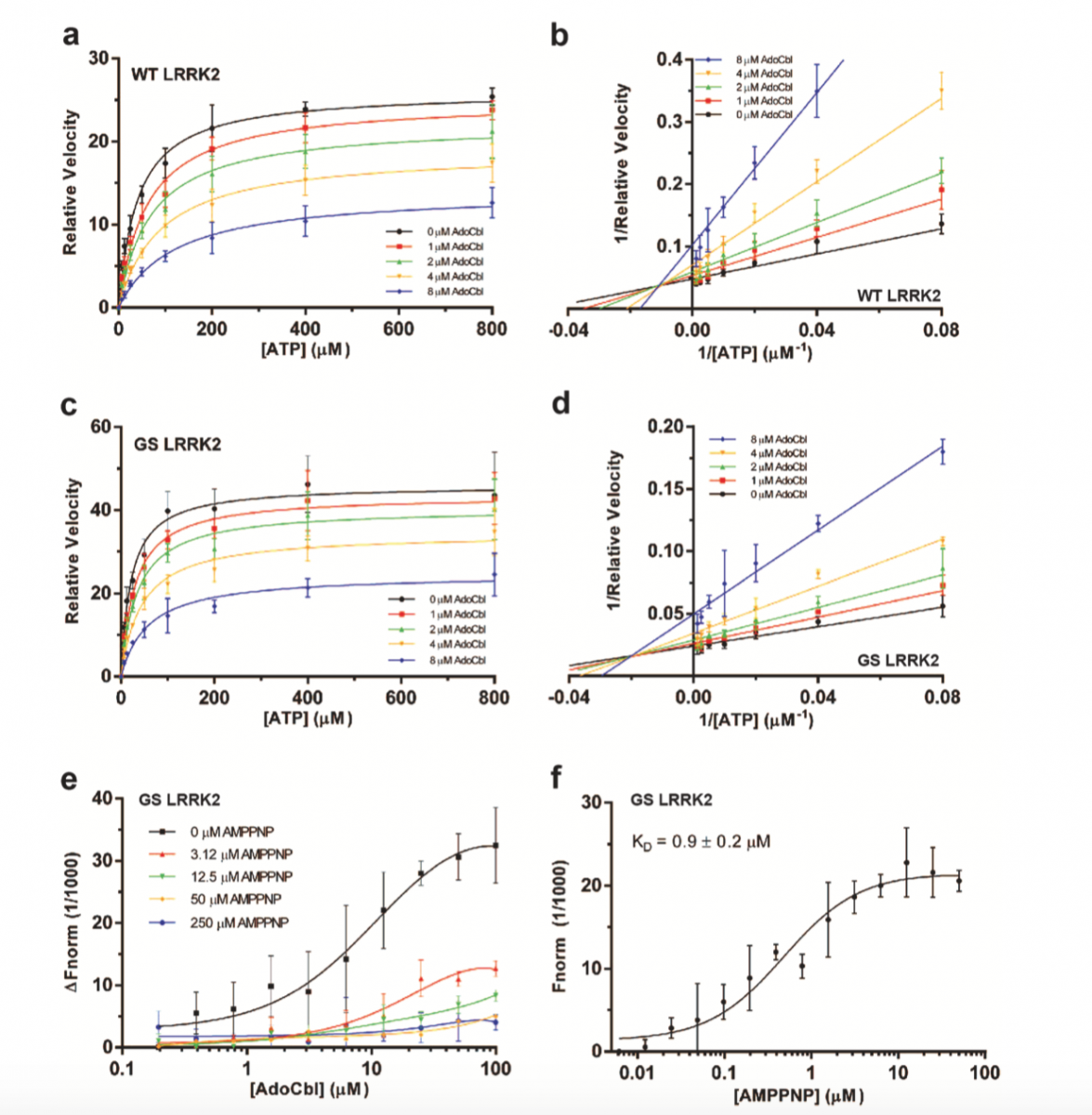
LRRK2 Protein Domain Structure Display and Pathogenic Site Distribution
LRRK2 inhibitor might be a good method to treat PD since PD patients have the problem of LRRK2 protein hyperactivity inside their bodies!
Research method
Researchers purified LRRK2 protein from mouse’s brain tissue and conducted high throughput screening of 2,080 drugs approved by FDA, to eventually discover an excellent LRRK2 inhibitor, which is the VB12 people are familiar with (trade name: Adenosylcobalamin, AdoCbl).
VB12 is an LRRK2 inhibitor with a brand-new mechanism. Researchers finally locked onto their target on VB12 in conjunction with the epidemiological evidence that PD patients lack VB12.
5’-deoxyladenosylcobalamin (AdoCbl) is one of...


































 (All Rights Reserved)