
In the field of oncology, Opdivo and Keytruda, as core immunotherapy agents for PD-1 inhibitors, have delivered significant survival benefits to patients with a variety of cancers. With its excellent efficacy and wide range of indications, Keytruda and Opdivo have occupied an extremely important position in the global oncology market. Their market performance not only solidifies their lofty position as a leader in immunotherapy, but also demonstrates the central role of PD-1 inhibitors in cancer treatment. In the second quarter of 2024, Keytruda and Opdivo achieved theie sales performance of USD7.27 billion and USD2.39 billion respectively, ranking first and third in oncology drugs (the second was Johnson & Johnson /Genmab's multiple myeloma drug Darzalex at USD2.88 billion). Figure 1 shows the 2023 sales volume and indications for the 10 types of PD-1 inhibitor oncology products approved by the FDA.
Comparison of Sales and Indications of PD-1 Inhibitor Approved by the FDA
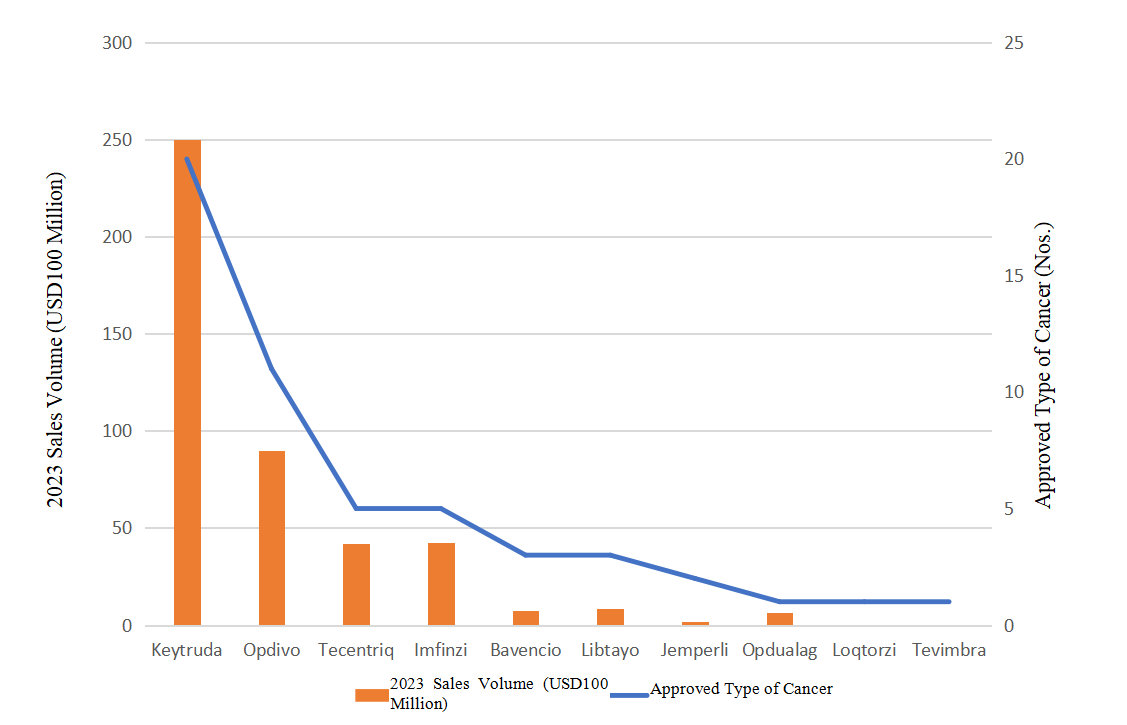
Figure 1. Comparison of Sales Volume and Approved Indications of PD-1 Inhibitor Approved by the FDA Oncology Drugs in 2023. (Note: Loqtorzi and Tevimbra were approved in 2022 and 2023 respectively, with no sales volume data for 2023)
Although PD-1 inhibitors are still an important pillar of tumor immunotherapy, with the continuous progress of scientific research, a series of new drugs are providing patients with more treatment options. These innovative therapies show unique mechanisms and potential to complement PD-1 inhibitors, opening new doors for cancer treatment and allowing us to see the possibility of a more diverse tumor treatment in the future.
1. Novel Therapies beyond PD-1 Inhibitors
Checkpoint inhibitors have revolutionized cancer treatment, but they still face powerless cases and patients. Some patients receive PD-1 inhibitor drugs, but the disease is still progressing. In terms of the gaps left behind by PD-1, Replimune believes that their cancer vaccine RP1 (vusolimogene oderparepvec) has the potential to become the go-to protocol for melanoma patients who have not responded to PD-1 inhibitors, and they have published impressive IGNYTE test data.
RP1 is an oncolytic immunotherapy based on HSV-1 (herpes simplex virus 1) gene modification. RP1 can selectively infect and kill cancer cells without serious damage to normal cells. After infecting cancer cells, RP1 replicates and destroys these cells, releasing tumor antigens. RP1 can not only kill cancer cells directly, but also activates the patient's immune system through the release of tumor antigens, resulting in a systemic immune response to the tumor. This immune activation works like a vaccine, helping the body recognize and attack other cancer cell. In addition, RP1 also expresses GM-CSF (cell-macrophage colony-stimulating factor) and fusion proteins. GM-CSF can stimulate antitumor cells in the immune system (such as dendritic cells and macrophages) to enhance their ability to recognize and kill cancer cells. By enhancing the display of tumor antigens, GM-CSF makes cancer cell death have more immunogenicity, helping to stimulate a stronger immune response. GM-CSF's expression can also enhance the local and systemic immune response, prompting the immune system to recognize and attack distant tumor lesions. Moreover, the GALV-GP R protein encoded by RP1 enhances the tumor killing capacity of the virus and increases the cell death of immunogenicity. In other words, RP1 not only uses the oncolytic properties of HSV-1 to directly attack cancer cells, but also stimulates a comprehensive immune response through the immune-enhancing effects of GM-CSF, thereby improving the therapeutic effectiveness of cancer.
Clinical data for the RP1 vaccine came from 140 melanoma patients in IGNYTE's solid tumor tests. The...


























 (All Rights Reserved)