

POOR MEASUREMENT PROCEDURES SLOW DOWN EXPERIMENTATION
Another problem that can reduce the speed and quality of process development is the measurement systems used to collect the data, i.e, availability of good methods and the efficiency with which the analytical laboratory is operated. Measurements enable us to see the effects of the variables driving
the process and build models that are used to develop the design space.
The role of good measurements often is overlooked. Poor laboratory performance can slow down development if:
• methods are not available when needed or have been developed poorly, producing misleading test results that slow the development of process understanding
• laboratory testing procedures and scheduling are inefficient, producing delays in getting the results back from the laboratory.
The value of good analytical methods is lessened if it takes a long time to get the samples analyzed.
EXAMPLE: STREAMLINING R&D WORK PROCESSES
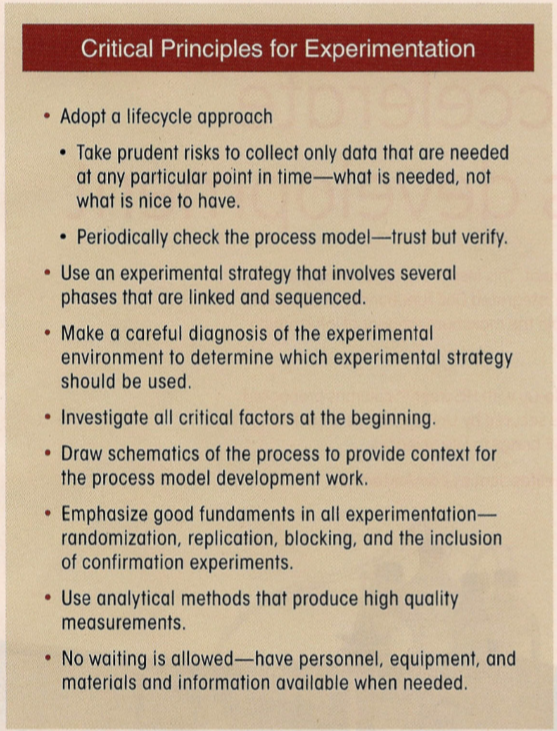
As noted above, developing good experimentation strategies to design, analyze, and interpret experiments is necessary but not sufficient for speeding up the improvement of upstream productivity. You also must streamline your experimentation work processes to get the full benefit, of Quality by Design. A critical issue is the scheduling of experimental work. You lose the benefit if you have to wait to run the experiments.
In an experimental program, a screening experiment was designed, the personnel were assembled and ready to conduct the experimental runs.
Unfortunately, the lead scientist couldn't make the process to work properly because of mechanical difficulties.
The personnel waited for two days and were then assigned to other projects. The experiment finally began two weeks later.
The scheduling and personnel acquisition had to be repeated. A significant amount of time and resources would have been saved if the process operation had been mastered before scheduling the screening experiment to be run.
The availability (flow) of information, materials, personnel, measurements, and equipment affects the flow of experimentation.
One of the most common inefficiencies is that there is a lot of waiting around: tasks are performed late; or personnel, equipment, and materials are not
available when needed; standards are not used, making it difficult to determine what was done and to compare to other work.
The solution to this problem is to use Lean principles to streamline the processes and procedures used to do the experimental work. Eliminating complexity and wasted time and effort results in experimentation being speeded up and scientists having more time to do creative work.
Kamm and Villarrubia report on an initiative that used Lean principles to streamline an analytical Iaboratory. The incoming workload on the quality control laboratory was variable in both volume and mix. Throughput time was >15 days.
Lean principles were used for this initiative. A 55 program identified and labeled equipment, marked bench space, and delineated storage areas. Lean process design principles were used to dedicate equipment and people to a set of products.
This new design for the flow improved in throughput time by 53%, reduced personnel utilization by 25%, and accelerated material release by 14%. This example shows how applying Lean principles can speed up the flow of analytical testing.
CONCLUSION
A critical component of using Quality by Design to increase process understanding and improve upstream productivity is speeding up the experimentation associated with developing new and existing products and improving processes.
Experience has shown that this can be accomplished by developing a strategy for experimentation that diagnoses the experimental environment to determine the best experimental design to use. This strategy also takes into account the environmental variables that affect the process. It also has been found that the quality and availab...
























 (All Rights Reserved)