

STREAMLINING EXPERIMENTATION
Critical to success is the development of a strategy of experimentation, which streamlines the experimental process. Such a strategy, summarized in Table I, identifies three experimental environments: screening, characterization, and optimization.
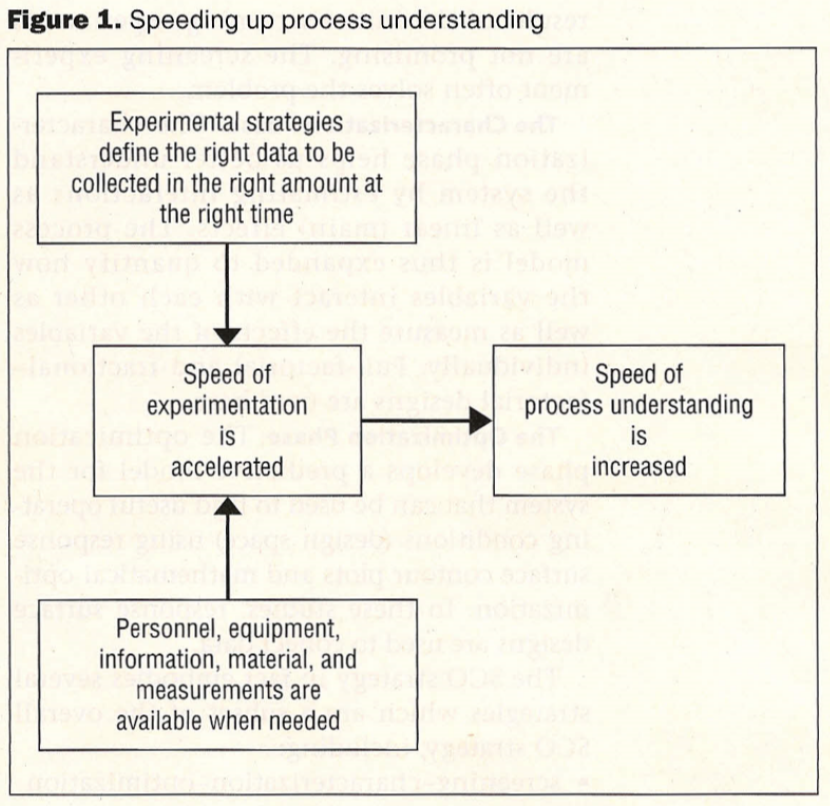
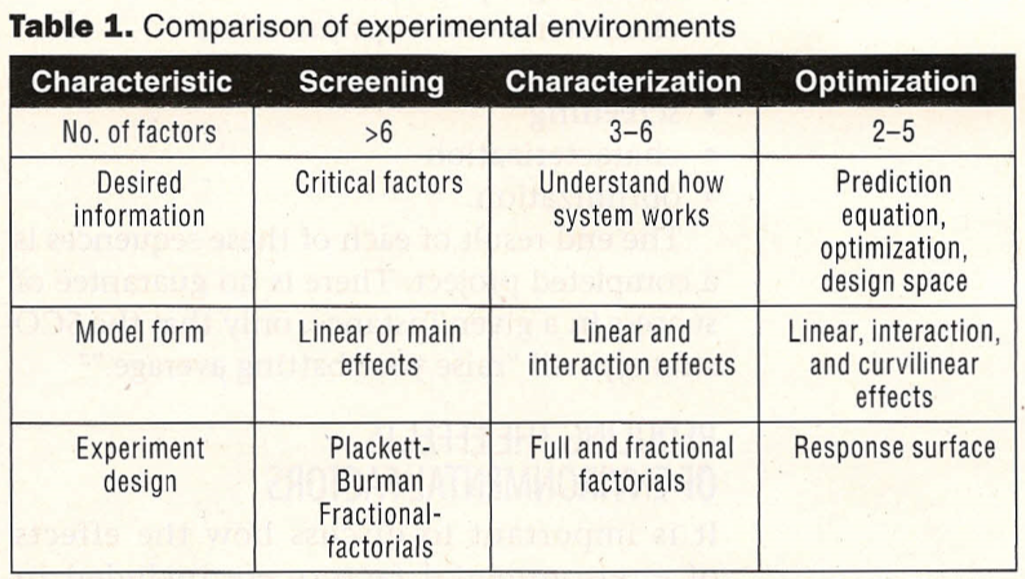
The objectives of each of the three phases are summarized in Table 1. The strategy sequences and links together a variety of
experimental designs, which enables scientists to achieve greater results than they could achieve previously using the same DOE
techniques in isolation.
The strategy used depends on the experimental environment. These characteristics involve program objectives, the nature of the factors and responses, resources available, quality of the information to be developed, and the theory available to guide the experiment design and analysis.
A careful diagnosis of the experimental environment along these lines can have a major effect on the success of the experimental
program."
The screening-characterization-optimization (SCO) strategy is illustrated by the work of Yan and Le-he, who describe a fermentation optimization study that uses screening followed by an optimization strategy.e In this investigation, 12 process variables were optimized. The first experiment used a 16-run Plackett-Burman screening design to study the effects of the 12 variables. The four variables with the largest effects were studied subsequently in a 16-run optimization experiment. The optimized conditions increased fermentation yield by 54%.
The Screening Phase. The screening phase explores the effects of a large number of variables with the objective of identifying a smaller number of variables to study further in characterization or optimization experiments. Screening studies typically use fractional-factorial and Plackett-Burman designs to collect data.
More screening experiments involving additional factors may be needed when the results of the initial screening experiments are not promising. The screening experiment often solves the problem.
The Characterization Phase.The characterization phase helps us better understand the system by estimating interactions as well as linear (main) effects. The process model is thus expanded to quantify how the variables interact with each other as well as measure the effects of the variables individually. Full-factorial and fractionalfactorial designs are used here.
The Optimization Phase. The optimizationphase develops a predictive model for the system that can be used to find useful operating
conditions (design space) using response surface contour plots and mathematical optimization.
In these studies, response surface designs are used to collect data.
The seo strategy in fact embodies several strategies which are a subset of the overall seo strategy, including: -.
• screening-characterization-optimization
• screening-optimization
• characterization-optimization
• screening-characterization
• screening
• characterization
• optimization.
The end result of each of these sequences is a completed project. There is no guarantee of success in a given instance, only that the seo
strategy will "raise your batting average."?
REDUCING THE EFFECTS OF ENVIRONMENTAL FACTORS
It is important to discuss how the effects of environmental factors are included in the experimental strategy. Part of diagnosing the. experimental environment is identifying environmental variables, which often are overlooked. Even the best strategy can be defeated if the effects of environmental
variables are not properly taken into account. Environmental variables include factors such as bioreactors, raw material lots, operating teams, ambient
temperature, and humidity. Recognizing the effects of variation from environmental factors, can go a long way in ensuring that the' resulting data are not biased.
Special experimental strate...


























 (All Rights Reserved)