
Bispecific antibodies (BsAbs), also known as "dual antibodies," are artificially engineered antibodies prepared through techniques such as cell fusion, recombinant DNA, and protein engineering. They can simultaneously or sequentially bind to two different antigens or two different epitopes of the same antigen. Compared to monoclonal antibodies (mAbs), BsAbs offer advantages such as dual-targeted signal blockade, prevention of drug resistance, and enhanced internalization.
Due to the unique advantages of BsAbs, there has been an increasing number of players entering the field of bispecific antibodies. According to publicly available data, the number of clinical trials related to BsAbs has been continuously increasing at a rate of 20.44% per year. Currently, there have been 13 approved bispecific antibodies globally. What new developments are there in the field of bispecific antibodies this year?
Approved Bispecific Antibody Products Worldwide
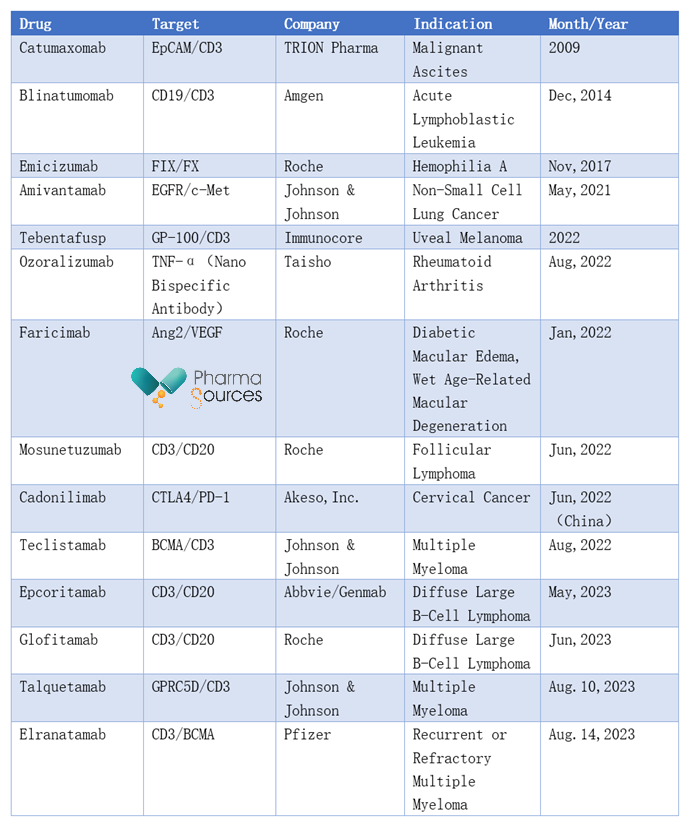
(Source: Publicly Available Information)
Since 2023, a total of four bispecific antibody drugs have been approved. On May 19, 2023, AbbVie and Genmab announced that the FDA approved their bispecific antibody drug Epcoritamab (trade name: Epkinly) for the treatment of relapsed or refractory diffuse large B-cell lymphoma. This drug is a CD3/CD20 bispecific antibody that can simultaneously target the CD20 protein on B cells and the CD3 protein on T cells to achieve the killing of CD20-positive cancer cells.
On June 15, 2023, the FDA approved Roche's Glofitamab (trade name: Columvi) for the treatment of relapsed or refractory diffuse large B-cell lymphoma (DLBCL) or large B-cell lymphoma (LBCL) originating from follicular lymphoma in adult patients who have received at least second-line or higher systemic therapy. Epcoritamab is Roche's second CD3/CD20 bispecific antibody approved by the FDA.
On August 10, 2023, the FDA approved Johnson & Johnson's bispecific antibody drug Talquetamab (trade name: Talvey) for the treatment of relapsed or refractory multiple myeloma (MM) in adult patients who have previously received at least four treatments, including proteasome inhibitors, immunomodulatory agents, and CD38 antibodies.
Talquetamab is a GPRC5D/CD3 bispecific antibody. GPRC5D (G-protein coupled receptor family C group 5 member D) is an orphan receptor highly expressed on MM plasma cells. Its overexpression is closely related to poor prognosis and tumor burden in MM patients, and it is independently expressed from B-cell maturation antigen (BCMA). Talquetamab can activate T cells with CD3 receptors and induce their killing of GPRC5D-positive MM tumor cells, thus exerting an anti-tumor effect.
On August 14, 2023, the FDA approved Pfizer's Elranatamab (trade name: Elrexfio) for the treatment of relapsed or refractory MM patients who have previously received at least four therapies, including proteasome inhibitors (PI), immunomodulatory agents (IMiD), and anti-CD38 monoclonal antibodies.
Elranatamab is a humanized IgG2a T-cell-engaging bispecific antibody designed to target BCMA highly expressed on tumor cells and CD3 on T cells.
Chinese bispecific antibody financing in 2023
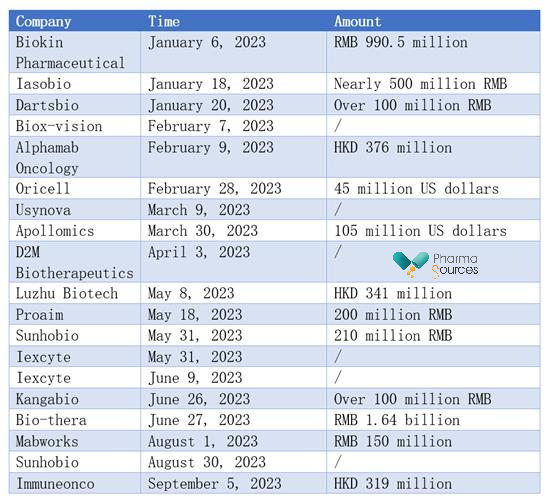
In addition to the four bispecific antibody drugs that have been approved and launched, the bispecific antibody field has also seen multiple financing activities this year. According to incomplete statistics, more than 20 Chinese companies in the bispecific antibody field have completed financing since 2023.
Financing situation of Chinese bispecific antibody companies in 2023

























 (All Rights Reserved)