
Many people consider that the status of chemotherapy in cancer treatment has fallen considerably and some even consider chemotherapy to be out-of-date in recent years with the occurrence of targeted drugs and immunotherapy. The bias against chemotherapy has caused many tumor patients who need chemotherapy originally to reject chemotherapy. Is chemotherapy useless? Has oncology entered the era requiring no chemotherapy?
A study published in the authoritative journal: Lancet Oncology brings a shocking viewpoint: despite many emerging treatment methods to appear in the future, global chemotherapy demands will be doubled in 2040, and China will be the country with the highest demands.
Chemotherapy is Out-of-date?
Background
The incidence of cancer (excluding non-melanomatous skin cancers) is projected to rise from 17 million to 26 million between 2018 and 2040. A large proportion of these patients would be likely to derive benefit from chemotherapy, but no studies so far have quantified current and projected global chemotherapy demands. The study aimed to estimate changes in global and regional demands for first-course chemotherapy and the cancer physician workforce between 2018 and 2040 if all patients were treated according to guidelines.
The study was conducted by researchers from the University of New South Wales, Ingham Institute for Applied Medical Research, Kinghorn Cancer Centre, Liverpool Cancer Therapy Centre, and International Agency for Research on Cancer, Lyon. They used the best-practice guidelines, patient characteristics, and cancer stage data from the U.S. and Australia to calculate the proportions of newly diagnosed cancer patients benefiting from chemotherapy, and then applied those proportions to estimate the incidence of cancer in global adults and children between 2018 and 2040 to project the chemotherapy demands of global cancer patients.
Findings
By 2040, the number of new cancer cases is projected to increase to 26 million in the world, and 15 million are estimated to need chemotherapy, with the absolute increase of 5.20 million (by 53%).
The most common indications for chemotherapy worldwide in 2040 will be lung cancer (accounting for 16.4% of the total cases, 2,455,137/14,984,560), breast cancer (12.7%, 1,898,740), and colorectal cancer (11.1%, 1,678,153). The absolute increases of cases of those three cancers requiring chemotherapy are projected to be the largest between 2018 and 2040. The relative increases of cases of gallbladder cancer and bladder cancer requiring chemotherapy are projected to be the largest between 2018 and 2040, separately being 77% and 66% (as shown in the following Table 1).
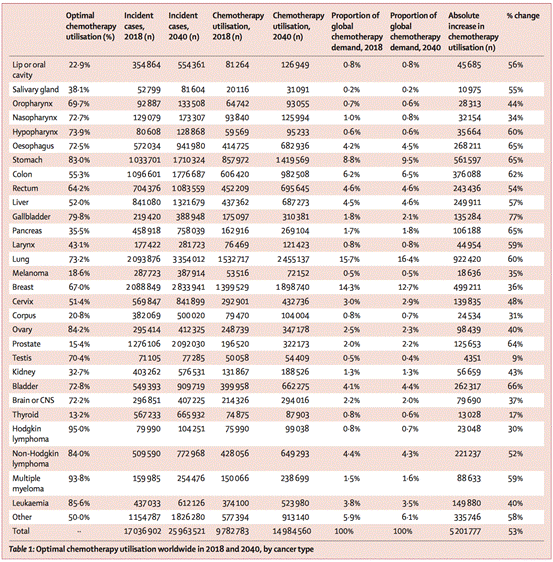
Table 1 Optimal Chemotherapy Utilization in 2018 and 2040 by Cancer Type
The study estimated that the optimal chemotherapy utilization in seven countries would be lower than 50%, while that in 36 countries would be 60% or higher (as shown in the following Fig. 1).
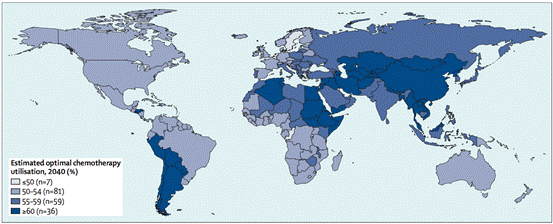
Fig. 1 Proportions of Patients Receiving First-course Chemotherapy in Countries in 2040
From the perspective of regions, among the 15 million people requiring chemotherapy in 2040, 35% will live in East Asia, 11.5% in Central and South Asia, and 9.5% in the north of the U.S. During 2018-2040, the largest increases of chemotherapy demands are projected to occur in East Africa (115% growth), Central Africa (114% growth), West Africa (100% growth), and West Asia (99% growth). It’s worth noting that the highest chemotherapy demands will be...
























 (All Rights Reserved)