

Unlike conventional temperature-sensitive pharmaceutical products, cell therapy products have the most stringent requirements for cold chain logistics. In this article , we gave you a brief overview of what cell therapy products are, the logistical challenges these products pose, and best practices for maintaining cell therapy cold chain.
In this article, we will dive deeper into cryogenic technology used at every step of the cold chain supply chain.
So, without further ado, let’s dive right into the article!
Understanding Cryogenic Cold Chain Technology
What is Cryogenic Cold Chain Technology?
Cryogenic Cold Chain Technology refers to the process of preserving and transporting highly sensitive biological materials, such as cell therapy products, at ultra-low temperatures. The temperatures used in this technology fall below -150°C and can be achieved using liquid nitrogen vapor (-196°C).
What makes cryogenic cold chain technology unique, and challenging is that, unlike standard cold chain systems that use refrigeration temperatures (2-8°C) or freezing temperature (-20°C), cryogenic cold chains are designed to maintain cellular integrity and functionality over extended periods by halting biological activity and putting the cells into a suspended state.
Cryogenic Cold Chain Technology for Cell Therapy Products
Cell therapy products are derived from live mammalian cells, which makes them particularly sensitive to temperature fluctuations. At cryogenic temperatures, cellular metabolic processes are nearly completely stopped, preventing cellular degradation and death during storage and transportation. Thus, cryogenic cold chain technology extends the shelf life of these perishable products, enabling long-term storage and transportation without losing their viability.
Cryogenic conditions also allow for the decoupling of manufacturing from clinical administration, reducing the time pressures of "just-in-time" logistics, which currently dominate the supply chain for cell and gene therapies.
Cryogenic vs. Traditional Cold Chain Methods
While cryogenic cold chain technology is still developing, traditional cold chain methods are already well-established for biologics like vaccines, monoclonal antibodies, and other temperature-sensitive pharmaceuticals. However, knowing the key differences between the two is important for understanding the need for developing cryogenic methods for cell therapy products.
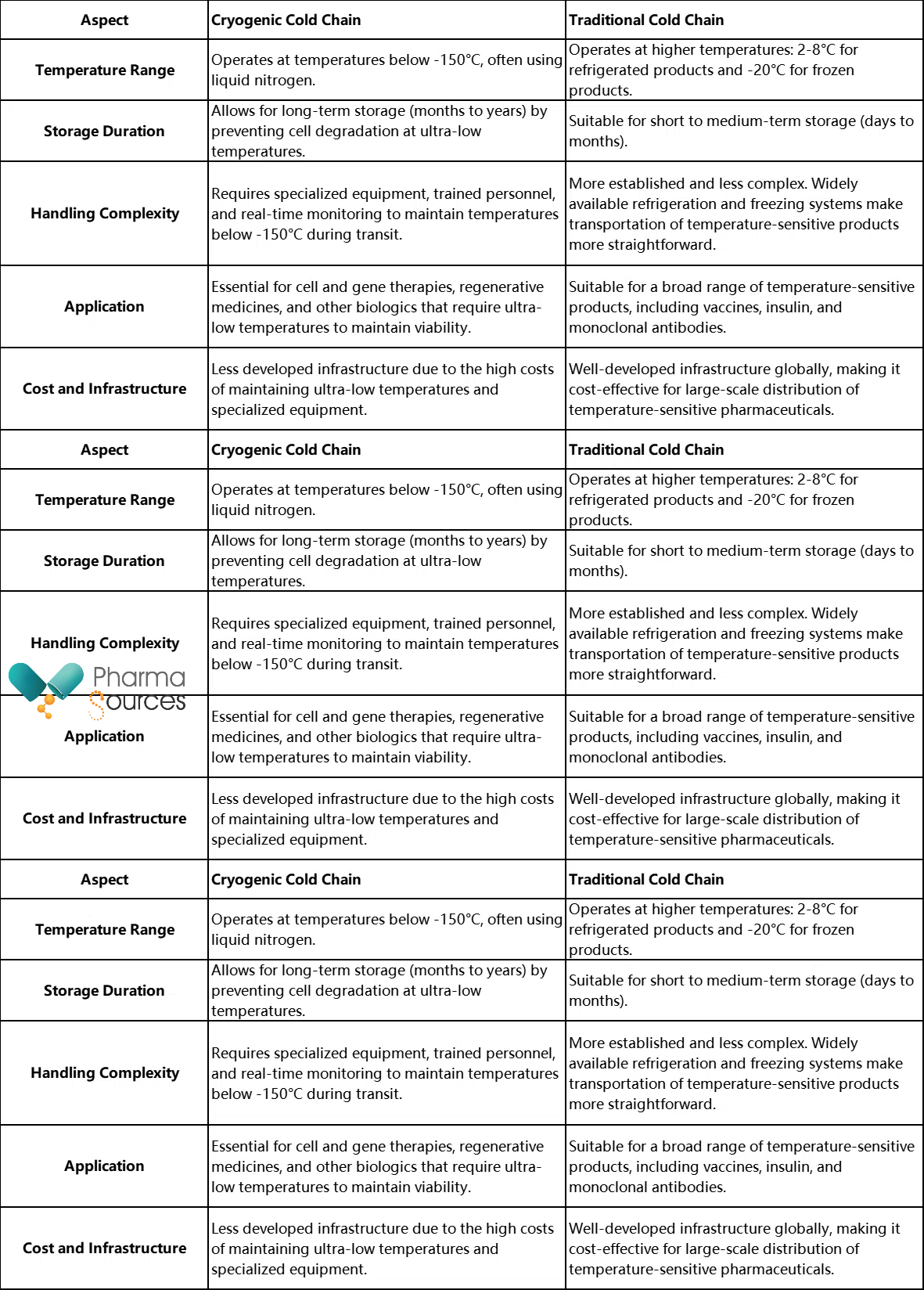
In the following table, we have summarized how both these methods compare in different aspects, including temperature range, storage duration, handling complexity, application, cost and infrastructure.
Development of Cryogenic Cold Chain Technology
We know for a fact that, unlike traditional cold chains, cryogenic systems are specifically developed to maintain ultra-low temperatures (below -150°C). However, the development of these systems faces significant technological and commercial challenges.
Some of the most common elements used for the development of cryogenic cold chain technology throughout the supply chain are:
Cryogenic Freezers
LN2 Storage Freezers
Liquid Nitrogen (LN2) storage freezers are the most common type of cryogenic freezers used in cell therapy storage. LN2 storage freezers are cylindrical stainless-steel vessels, the bottom of which are filled with liquid nitrogen. The resulting vapor phase nitrogen fills the rest of the chamber, where the product is placed above the liquid level in racks. Temperatures inside the chamber vary, with the lowest temperatures of around -190°C at the bottom to the highest, around -120°C at the top. This temperature variation in LN2 storage freezers is critical as products placed higher in the chamber are warmer than those stored lower.
The biggest advantage of LN2 freezers is their ability to maintain ultra-low temperatures without electrical power for extended periods—often for days, making them ideal for situations where power outages or supply chain d...



























 (All Rights Reserved)