

Have you ever imagined as an expert in drugs manufacturing that Industry 4.0 can be applied in pharma world? Believe it or not! The future now is for the autonomous, or as called SMART factories and operations.
Insight No. 1: At first, What is meant by Industry 4.0?
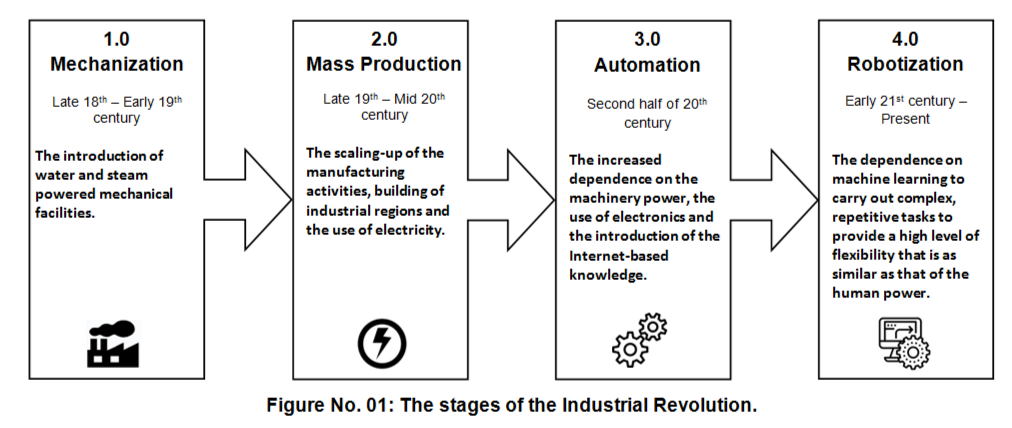
Industry 4.0 refers to the Fourth Industrial Revolution. Indeed, the industrial revolution has gone into four stages as illustrated in the following Figure No. 01:
Insight No. 2: Robotization and Digital Transformation: Are these two terms similar?
Digital transformation literally means: the application of technology to transform any process from being manual to a digital or an automated one. In other words, Digital Transformation is as same as the concept of Business Process Automation.
On the other hand, Robotization means: the introduction of robots to carry out the industrial tasks. So, this word refers to the automation of a process by the use of a robotic device.
Eventually, while these terms are not usually used interchangeably, in both cases, the applicant is interested in the creation of an automated (i.e. digital) business process in order to increase the quality of the output while decreasing the cost of poor quality.
Insight No. 3: What are the main key technology trends of Industry 4.0 in the pharma world? And What are their benefits?
1. Additive Manufacturing AM: this term refers to the use of a set of technologies to build a three-dimensional 3D model using a 3D software in a fast and customized way. There are many applications of this trend, including but not limited to: the printing of a Polypill, which helps tailor the medications for each patient based on his needs. A Polypill containing specific amounts of different Active Pharmaceutical Ingredients APIs, depending on the underlying medical conditions, can be printed in the hospital setting and given to a specific patient. The use of Polypill is expected to have many advantages, such as: increasing the adherence of elderly patients to their medications (i.e. eliminates the need to administer different types of pills during the day), on-demand printing of any drug in case of emergencies, and since the Polypill will be taken soon after being 3D printed, this might help to reduce the need of conducting a long-term stability study to evaluate the API shelf-life.
2. Augmented Reality AR: augmented reality activities help to establish 3D graphics in a real-world environment, where models or prototypes of products and devices can be examined in their real size, magnified or minimized. As an example, a surgeon can utilize this technology to build a 3D kidney model before doing a partial nephroectomy (i.e. surgical removal of a kidney) to help him take the proper surgical decision. Also, a doctor can build a 3D model for a specific organ to virtually study the progression of a certain disease, to evaluate the mechanism of action of a potential therapeutic entity, or to educate the patient about his medical condition. Another interesting application is the process simulation and modeling, by which, a mathematical model can used to build a virtual representation in order to predict the future state of any pharmaceutical process.
3. Autonomous Robots: robotization of any process leads to many benefits, such as: decreasing the defect rate, providing a higher level of quality and better work space utilization. Usually, people can work with robots on carrying out different tasks using a smart sensor, equipped with a human-machine interface. Robotization has many applications in the pharmaceutical industry; it can be applied in the warehouse management as robots will help to do an automated pick-place step in a vertical manner and a material transfer step in a fast way. Also, a robotic cloud lab can be e...

























 (All Rights Reserved)