Product Description
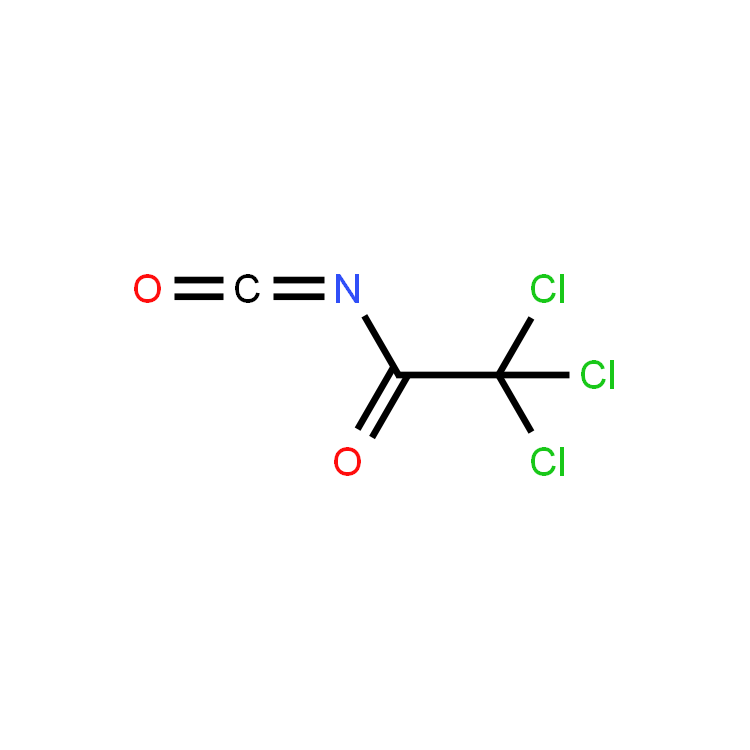
Trichloroacetyl isocyanate、3019-71-4
AI Product Description
*The following content is generated by AI and is for reference only.
Trichloroacetyl isocyanate (TCI) is a highly reactive and specialized chemical reagent primarily utilized in organic synthesis and pharmaceutical manufacturing. With the Chemical Abstracts Service (CAS) registry number 594-10-7, this compound features the molecular formula C2Cl3NO. Structurally, it consists of an isocyanate functional group (-N=C=O) attached to a trichloroacetyl moiety, creating a molecule with significant electrophilic character due to the electron-withdrawing effect of the three chlorine atoms. This unique electronic configuration makes TCI exceptionally effective for introducing specific acyl groups into complex molecular frameworks.
The primary application of Trichloroacetyl isocyanate lies in the synthesis of heterocyclic compounds, particularly pyrimidines and other nitrogen-containing rings essential for drug development. It serves as a critical intermediate in the production of various agrochemicals and active pharmaceutical ingredients (APIs). Researchers frequently employ TCI to protect amine groups or to facilitate cyclization reactions where precise control over reaction kinetics is required. Its ability to react vigorously with nucleophiles, such as alcohols, amines, and water, allows for the rapid formation of ureas, carbamates, and amides under controlled conditions.
However, handling Trichloroacetyl isocyanate demands strict safety protocols. The substance is moisture-sensitive and reacts violently with water to release toxic hydrogen chloride gas and carbon dioxide. Consequently, it must be stored in a cool, dry place under an inert atmosphere, typically within sealed containers made of compatible materials like glass or specific fluoropolymers. Personal protective equipment, including respirators, chemical-resistant gloves, and eye protection, is mandatory during manipulation to prevent inhalation, skin contact, or ingestion. In industrial settings, engineering controls such as fume hoods are essential to mitigate exposure risks. Despite its hazardous nature, TCI remains an indispensable tool in advanced chemical research, enabling the efficient construction of complex molecular architectures that would otherwise require multi-step, less efficient synthetic routes. Its continued use underscores the balance between chemical utility and rigorous safety management in modern laboratories.





 (All Rights Reserved)
![8-Oxa-1,3-diazaspiro[4.5]decane-2,4-dione](https://eimg.pharmasources.com/image/product/20250403/60fa7223d5a34f24138486ceea0ffb15jpg)
![6,8-Dioxo-5,7-diazaspiro[3.4]octane-2-carboxylic acid](https://eimg.pharmasources.com/image/product/20250403/02effeb5a7639bc84ff1f3add3c0c64fjpg)
![8,16-Diazadispiro[6.1.6.2]heptadecan-17-one](https://eimg.pharmasources.com/image/product/20250403/ca91cba8b87e53fc879f8d8764873a40jpg)