Category:
Other Antibiotics
CAS NO:
51025-85-5
Standard:
In-house Standards,

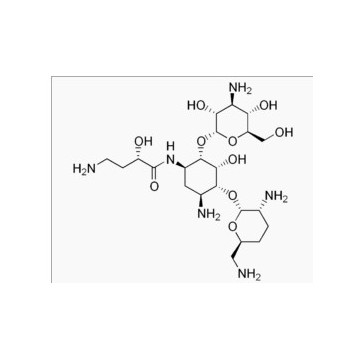

semisynthetic aminoglycoside antibiotic arbekacin
Arbekacin is used for the short term treatment of multi-resistant bacterial infections, such as methicillin-resistant Staphylococcus aureus (MRSA).
Aminoglycosides, such as Arbekacin, work by binding to the bacterial 30S ribosomal subunit, causing misreading of t-RNA which consequently, leaves the bacterium unable to synthesize proteins vital to its growth. Energy is needed for aminoglycoside uptake into the bacterial cell. Anaerobes have less energy available for this uptake, so aminoglycosides are less active against anaerobes. Aminoglycosides are useful primarily in infections involving aerobic, gram-negative bacteria, such as Pseudomonas, Acinetobacter, and Enterobacter.
Aminoglycosides, such as 'Arbekacin, inhibit protein synthesis in susceptible bacteria by irreversibly binding to bacterial 30S and 16S ribosomal subunits. Specifically Arbekacin binds to four nucleotides of 16S rRNA and a single amino acid of protein S12. This interferes with decoding site in the vicinity of nucleotide 1400 in 16S rRNA of 30S subunit. This region interacts with the wobble base in the anticodon of tRNA. This leads to misreading of mRNA so incorrect amino acids are inserted into the polypeptide leading to nonfunctional or toxic peptides and the breakup of polysomes into nonfunctional monosomes.
Company Shows



 (All Rights Reserved) (All Rights Reserved)