Product Description
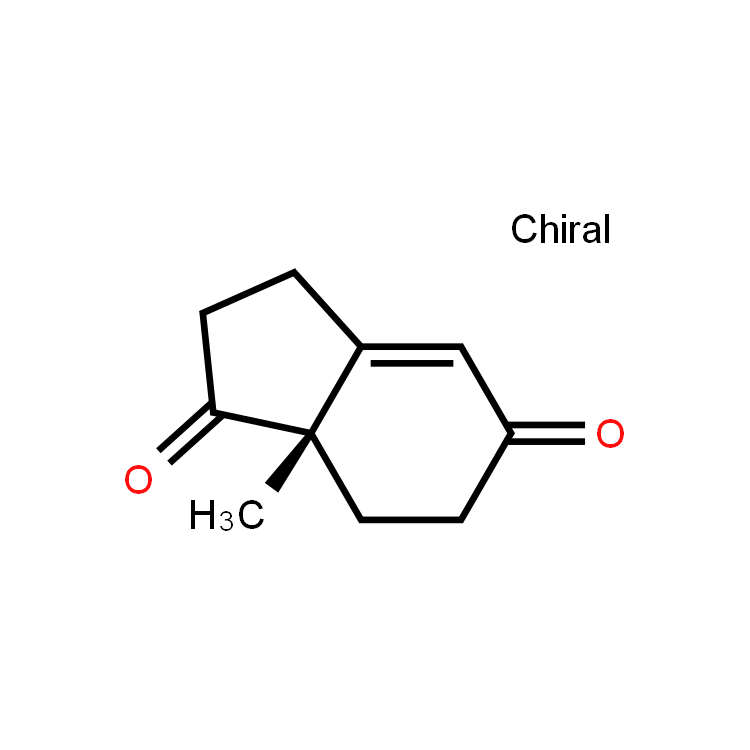
(S)-7a-Methyl-2,3,7,7a-tetrahydro-1H-indene-1,5(6H)-dione、17553-86-5
AI Product Description
*The following content is generated by AI and is for reference only.
(S)-7a-Methyl-2,3,7,7a-tetrahydro-1H-indene-1,5(6H)-dione is a sophisticated chiral organic compound belonging to the class of substituted tetralone derivatives. With the molecular formula C12H14O2 and a precise molecular weight of approximately 190.24 g/mol, this substance serves as a critical intermediate in modern medicinal chemistry and asymmetric synthesis. Its defining structural feature is the stereogenic center at the 7a-position, which imparts specific optical activity essential for the development of enantiomerically pure pharmaceutical agents. While the exact CAS number may vary slightly depending on specific commercial suppliers or salt forms, it is generally recognized within specialized chemical catalogs as a high-value building block for complex molecule construction.
The primary application of this compound lies in its utility as a chiral scaffold for synthesizing bioactive natural products and novel drug candidates. Researchers frequently utilize it as a starting material for constructing polycyclic frameworks found in various terpenoids and alkaloids. Due to its rigid bicyclic structure and reactive carbonyl groups, it facilitates diverse transformations such as aldol condensations, Michael additions, and reductive aminations. These reactions allow chemists to introduce functional diversity while maintaining stereochemical integrity, a crucial requirement for ensuring the efficacy and safety of new therapeutics. Furthermore, the (S)-enantiomer is specifically sought after when targeting biological receptors that exhibit strict stereoselectivity, minimizing potential off-target effects associated with racemic mixtures.
In industrial settings, this chemical is often employed in the research and development phases of agrochemicals and fine chemicals where precise molecular geometry dictates biological activity. Its stability under standard laboratory conditions makes it suitable for storage and transport, provided it is kept away from strong oxidizing agents and excessive heat. As the demand for green chemistry and efficient catalytic processes grows, (S)-7a-methyl-tetralone dione remains a versatile tool for creating sustainable synthetic pathways. It bridges the gap between simple aromatic precursors and complex heterocyclic systems, offering a strategic advantage in the rapid optimization of lead compounds. Ultimately, this molecule exemplifies the intersection of structural complexity and synthetic utility, driving innovation across multiple sectors of the chemical industry.











 (All Rights Reserved)
![8-Oxa-1,3-diazaspiro[4.5]decane-2,4-dione](https://eimg.pharmasources.com/image/product/20250403/60fa7223d5a34f24138486ceea0ffb15jpg)
![6,8-Dioxo-5,7-diazaspiro[3.4]octane-2-carboxylic acid](https://eimg.pharmasources.com/image/product/20250403/02effeb5a7639bc84ff1f3add3c0c64fjpg)
![8,16-Diazadispiro[6.1.6.2]heptadecan-17-one](https://eimg.pharmasources.com/image/product/20250403/ca91cba8b87e53fc879f8d8764873a40jpg)