Product Description
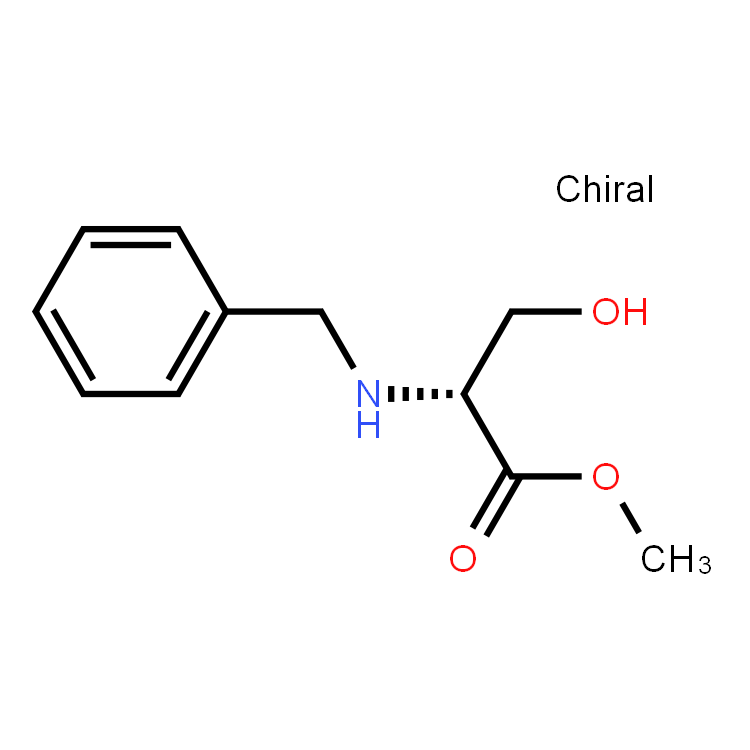
(R)-Methyl 2-(benzylamino)-3-hydroxypropanoate、131110-76-4
AI Product Description
*The following content is generated by AI and is for reference only.
(R)-Methyl 2-(benzylamino)-3-hydroxypropanoate is a specialized chiral organic intermediate widely utilized in the pharmaceutical and fine chemical industries. With the molecular formula C11H15NO3, this compound features a distinct stereochemical configuration at the C2 position, denoted by the (R) designation, which is critical for its biological activity and specificity in downstream synthesis. Its structural framework combines a methyl ester group, a secondary benzylamine moiety, and a vicinal hydroxyl group, creating a versatile scaffold for complex molecule construction. The primary Cas number associated with this specific enantiomer is typically distinct from its racemic or (S)-counterpart, ensuring precise identification for regulatory and research purposes, though exact verification against current databases is recommended for specific batch tracking.
The principal application of (R)-Methyl 2-(benzylamino)-3-hydroxypropanoate lies in the asymmetric synthesis of beta-amino acid derivatives and their corresponding peptidomimetics. Due to the inherent chirality of the molecule, it serves as an essential building block for developing biologically active compounds, including potential antiviral agents, enzyme inhibitors, and novel therapeutics targeting neurological disorders. The presence of the free hydroxyl group allows for further functionalization, such as etherification or esterification, facilitating the creation of diverse analogs with optimized pharmacokinetic profiles. Furthermore, this intermediate is frequently employed in the preparation of chiral ligands used in transition metal-catalyzed reactions, enhancing stereoselectivity in industrial manufacturing processes.
In laboratory settings, researchers utilize this compound to study structure-activity relationships (SAR), aiming to understand how specific stereochemical arrangements influence receptor binding affinity. Its stability under standard storage conditions makes it suitable for both small-scale academic investigations and larger-scale pilot production runs. However, handling requires adherence to safety protocols due to potential sensitization properties common among amine-containing esters. As the demand for enantiopure substances grows within the global pharmaceutical sector, high-purity sources of (R)-Methyl 2-(benzylamino)-3-hydroxypropanoate remain indispensable for advancing drug discovery pipelines and ensuring the efficacy of next-generation medicinal products.











 (All Rights Reserved)
![8-Oxa-1,3-diazaspiro[4.5]decane-2,4-dione](https://eimg.pharmasources.com/image/product/20250403/60fa7223d5a34f24138486ceea0ffb15jpg)
![6,8-Dioxo-5,7-diazaspiro[3.4]octane-2-carboxylic acid](https://eimg.pharmasources.com/image/product/20250403/02effeb5a7639bc84ff1f3add3c0c64fjpg)
![8,16-Diazadispiro[6.1.6.2]heptadecan-17-one](https://eimg.pharmasources.com/image/product/20250403/ca91cba8b87e53fc879f8d8764873a40jpg)