Product Description
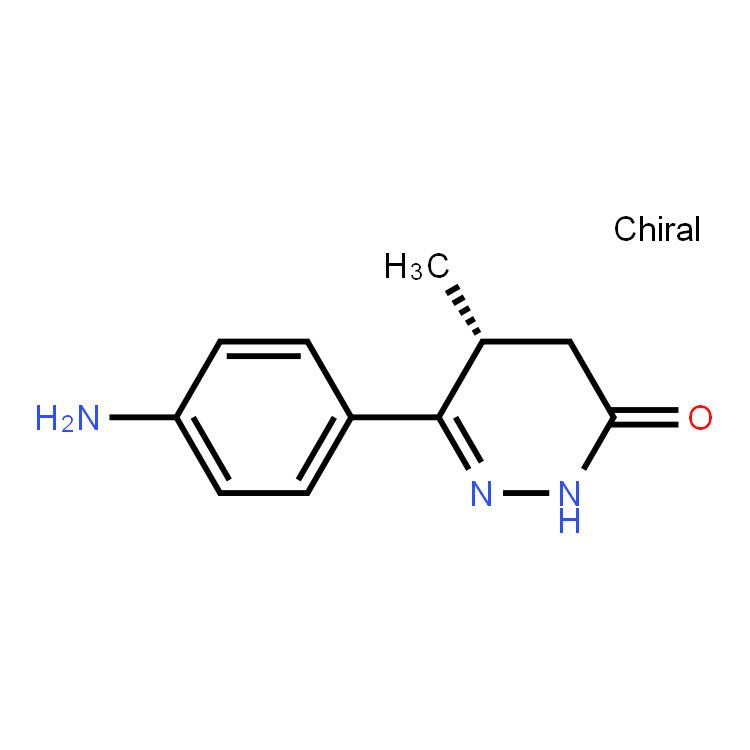
(R)-6-(4-Aminophenyl)-5-methyl-4,5-dihydropyridazin-3(2H)-one、101328-85-2
AI Product Description
*The following content is generated by AI and is for reference only.
(R)-6-(4-Aminophenyl)-5-methyl-4,5-dihydropyridazin-3(2H)-one is a chiral organic compound belonging to the pyridazinone class, widely recognized for its significance in medicinal chemistry and pharmaceutical research. With the molecular formula C10H11N3O, this molecule features a unique stereochemical configuration at the C5 position, designated as the (R)-enantiomer. The structure comprises a dihydropyridazinone core substituted with a methyl group and a 4-aminophenyl moiety, creating a scaffold that exhibits potential biological activity against various targets. While specific CAS registry numbers for individual enantiomers can vary depending on the vendor or synthesis method, this compound is often cataloged under distinct identifiers to differentiate it from its racemic mixtures or (S)-counterparts.
The primary utility of this chemical lies in its role as a key intermediate in the synthesis of novel therapeutic agents. Researchers utilize the (R)-isomer to investigate structure-activity relationships (SAR) in drug development, particularly for applications involving kinase inhibition, anti-inflammatory responses, or central nervous system disorders. The presence of the amino group on the phenyl ring allows for further functionalization, enabling the creation of complex heterocyclic derivatives with enhanced pharmacological profiles. Furthermore, the chiral nature of the molecule is crucial, as biological systems often exhibit high specificity toward one enantiomer over the other, making the pure (R)-form essential for accurate efficacy and toxicity studies.
In laboratory settings, this reagent serves as a building block for combinatorial chemistry libraries aimed at identifying new lead compounds. Its stability and reactivity make it suitable for coupling reactions and cyclization processes. Although not typically marketed as a final active pharmaceutical ingredient itself, its contribution to the pipeline of drug discovery is substantial. Scientists employ advanced spectroscopic techniques like NMR and HPLC to verify the purity and optical rotation of the (R)-enantiomer before utilizing it in preclinical assays. As the demand for targeted therapies grows, compounds like (R)-6-(4-Aminophenyl)-5-methyl-4,5-dihydropyridazin-3(2H)-one remain vital tools for advancing medical science and developing safer, more effective treatments for human diseases.





 (All Rights Reserved)
![8-Oxa-1,3-diazaspiro[4.5]decane-2,4-dione](https://eimg.pharmasources.com/image/product/20250403/60fa7223d5a34f24138486ceea0ffb15jpg)
![6,8-Dioxo-5,7-diazaspiro[3.4]octane-2-carboxylic acid](https://eimg.pharmasources.com/image/product/20250403/02effeb5a7639bc84ff1f3add3c0c64fjpg)
![8,16-Diazadispiro[6.1.6.2]heptadecan-17-one](https://eimg.pharmasources.com/image/product/20250403/ca91cba8b87e53fc879f8d8764873a40jpg)