Product Description
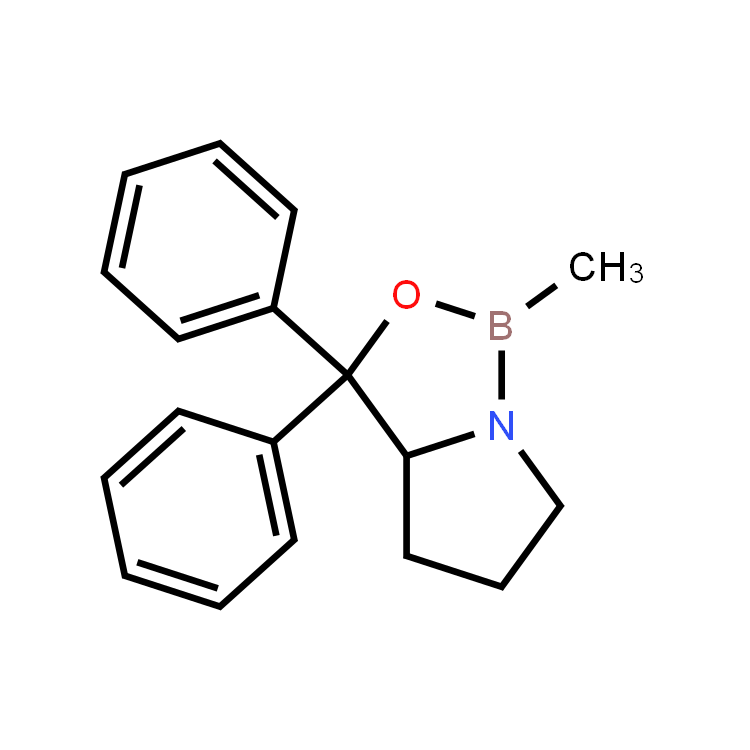
(R)-2-Methyl-CBS-oxazaborolidine、112022-83-0
AI Product Description
*The following content is generated by AI and is for reference only.
(R)-2-Methyl-CBS-oxazaborolidine, often referred to simply as (R)-CBS catalyst, is a highly efficient chiral organoboron compound widely utilized in asymmetric organic synthesis. With the molecular formula C13H16BNO and CAS Registry Number 107958-94-7, this reagent serves as a cornerstone for the enantioselective reduction of prochiral ketones. Its primary function lies in catalyzing the transfer of hydride from borane (BH3) or catecholborane to carbonyl groups, yielding optically active secondary alcohols with exceptional enantiomeric excess. The reaction proceeds under mild conditions, typically at low temperatures, ensuring high stereocontrol and minimal side reactions.
The catalyst operates through a unique Lewis acid-base mechanism where the boron atom coordinates with the oxygen of the ketone, while the oxazaborolidine ring creates a rigid chiral environment. This spatial arrangement directs the incoming hydride attack to one specific face of the carbonyl group, dictated by the (R)-configuration of the methyl substituent on the ring. Consequently, it predominantly produces (S)-alcohols from simple ketones, though substrate specificity can influence the absolute configuration. Due to its high turnover number and robustness, only catalytic amounts are required, making it economically viable for both laboratory-scale research and industrial manufacturing processes.
Applications of (R)-2-Methyl-CBS-oxazaborolidine span across the pharmaceutical industry, agrochemicals, and fine chemical sectors. It is indispensable for synthesizing complex chiral building blocks found in various bioactive molecules, including antibiotics, antivirals, and natural products. Furthermore, its utility extends to the production of fragrances and flavors where optical purity is critical for sensory properties. Despite its sensitivity to moisture, requiring anhydrous solvents like dichloromethane or tetrahydrofuran, the ease of handling and predictable outcomes have cemented its status as a standard tool in modern synthetic chemistry. Researchers frequently rely on this reagent to achieve stereoselectivity that is difficult to attain through other reduction methods, thereby streamlining the development of enantiopure drugs and materials.











 (All Rights Reserved)
![8-Oxa-1,3-diazaspiro[4.5]decane-2,4-dione](https://eimg.pharmasources.com/image/product/20250403/60fa7223d5a34f24138486ceea0ffb15jpg)
![6,8-Dioxo-5,7-diazaspiro[3.4]octane-2-carboxylic acid](https://eimg.pharmasources.com/image/product/20250403/02effeb5a7639bc84ff1f3add3c0c64fjpg)
![8,16-Diazadispiro[6.1.6.2]heptadecan-17-one](https://eimg.pharmasources.com/image/product/20250403/ca91cba8b87e53fc879f8d8764873a40jpg)