Product Description
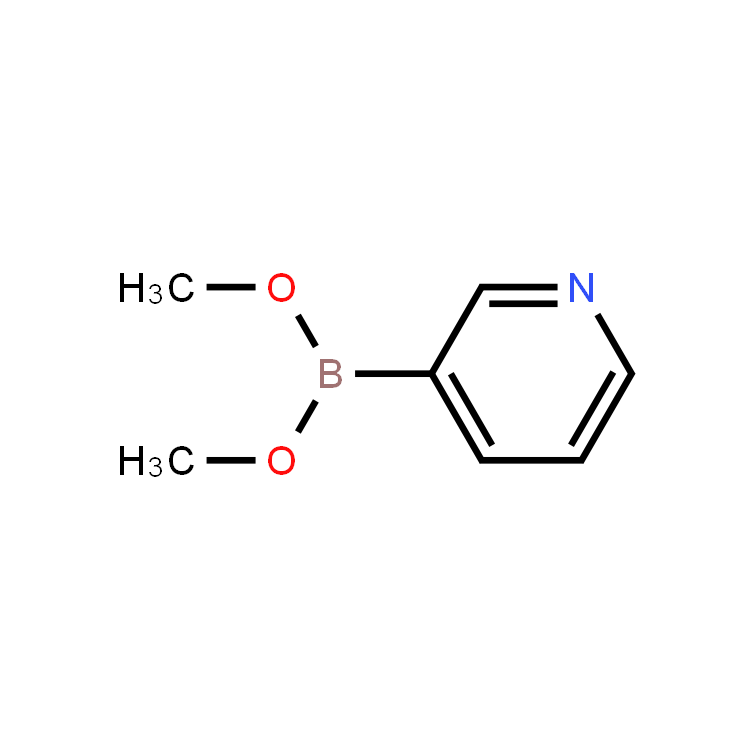
PYRIDINE-3-BORONIC ACID DIMETHYL ESTER、175885-77-5
AI Product Description
*The following content is generated by AI and is for reference only.
Pyridine-3-boronic acid dimethyl ester is a specialized organoboron compound widely utilized in modern organic synthesis, particularly within the realm of medicinal chemistry and materials science. Chemically characterized by a pyridine ring substituted at the third position with a boronic acid dimethyl ester group, this molecule serves as a versatile building block for constructing complex heterocyclic architectures. Its molecular formula is C7H10BNO2, reflecting the presence of seven carbon atoms, ten hydrogen atoms, one boron atom, one nitrogen atom, and two oxygen atoms. The specific CAS registry number assigned to this reagent is 129856-49-3, which facilitates precise identification and procurement in global chemical markets.
The primary utility of Pyridine-3-boronic acid dimethyl ester lies in its role as a key coupling partner in Suzuki-Miyaura cross-coupling reactions. In these catalytic processes, the boronate ester moiety reacts efficiently with aryl or vinyl halides in the presence of palladium catalysts to form biaryl or styryl structures. This reaction pathway is highly valued for its mild conditions, high tolerance toward various functional groups, and excellent regioselectivity. Consequently, it enables chemists to synthesize sophisticated pharmaceutical intermediates, agrochemical agents, and advanced electronic materials with precision. The dimethyl ester functionality offers distinct advantages over free boronic acids, including enhanced stability against oxidation and improved solubility in common organic solvents, thereby streamlining purification procedures and increasing overall reaction yields.
Beyond direct coupling applications, this compound acts as a crucial precursor for generating other pyridine-based derivatives. Researchers frequently employ it to introduce nitrogen-containing heterocycles into drug candidates, aiming to modulate biological activity, metabolic stability, or solubility profiles. Its structural integrity allows for further derivatization, making it an indispensable tool in library synthesis for high-throughput screening. As the demand for novel therapeutics and functional materials grows, the importance of reliable boron-based reagents like Pyridine-3-boronic acid dimethyl ester continues to expand, solidifying its status as a fundamental asset in contemporary synthetic laboratories worldwide.





 (All Rights Reserved)
![8-Oxa-1,3-diazaspiro[4.5]decane-2,4-dione](https://eimg.pharmasources.com/image/product/20250403/60fa7223d5a34f24138486ceea0ffb15jpg)
![6,8-Dioxo-5,7-diazaspiro[3.4]octane-2-carboxylic acid](https://eimg.pharmasources.com/image/product/20250403/02effeb5a7639bc84ff1f3add3c0c64fjpg)
![8,16-Diazadispiro[6.1.6.2]heptadecan-17-one](https://eimg.pharmasources.com/image/product/20250403/ca91cba8b87e53fc879f8d8764873a40jpg)