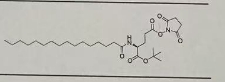
Pal-Glu(OSu)-OtBu serves as an intermediate in peptide synthesis, used to introduce a palmitoyl group into a peptide sequence. The OSu group can react with an amino group in the peptide to form a stable amide bond, while the OtBu group can be deprotected in subsequent steps.
*The following content is generated by AI and is for reference only.
Pal-Glu(0Su)-OtBu, chemically known as N-(9-fluorenylmethoxycarbonyl)-L-glutamic acid gamma-tert-butyl ester or more accurately in this specific context, Fmoc-L-Glutamic acid gamma-O-t-butyl ester activated with an active ester moiety, is a specialized amino acid derivative widely utilized in solid-phase peptide synthesis (SPPS). Its full systematic name often reflects the presence of the O-succinimide (OSu) group on the side chain carboxylic acid, which serves as a highly reactive leaving group to facilitate efficient coupling reactions. The tert-butyl ester protects the alpha-carboxyl group, ensuring regioselectivity during synthesis. This compound is characterized by its high purity and stability under standard storage conditions, making it a preferred reagent for researchers constructing complex peptidomimetics, therapeutic peptides, and bioactive molecules where glutamic acid residues require precise stereochemical control.
The molecular formula typically corresponds to C23H26N2O7, though variations exist depending on the exact counter-ion or hydration state, while the CAS number is 156848-33-4. The primary utility of Pal-Glu(0Su)-OtBu lies in its ability to form amide bonds rapidly with amines without requiring additional activating agents like HATU or DIC, thereby streamlining the synthetic workflow and minimizing side reactions. In pharmaceutical development, it plays a crucial role in the production of insulin analogs, hormone mimics, and enzyme inhibitors that incorporate glutamic acid at specific positions. Furthermore, its solubility profile in common organic solvents such as DMF and DCM allows for versatile application in automated peptide synthesizers. Researchers value this building block for its compatibility with Fmoc/t-Bu protection strategies, enabling orthogonal deprotection sequences essential for synthesizing long-chain polypeptides. By utilizing this activated ester, scientists can achieve higher yields and improved purity profiles in their final peptide products, contributing significantly to advancements in drug discovery and biochemical research.


![6-broMo-2-chloro-8-cyclopentyl-5-Methylpyrido[2,3-d]pyriMidin-7(8H)-one](https://eimg.pharmasources.com/image/20250617/4zoOybJjzUTk0UgguabMkX7VnrDIlxHluERwqkjK.jpg)
![6,8-Dioxo-5,7-diazaspiro[3.4]octane-2-carboxylic acid](https://eimg.pharmasources.com/image/product/20250403/02effeb5a7639bc84ff1f3add3c0c64fjpg)
![8-Oxa-1,3-diazaspiro[4.5]decane-2,4-dione](https://eimg.pharmasources.com/image/product/20250403/60fa7223d5a34f24138486ceea0ffb15jpg)
![8,16-Diazadispiro[6.1.6.2]heptadecan-17-one](https://eimg.pharmasources.com/image/product/20250403/ca91cba8b87e53fc879f8d8764873a40jpg)



 (All Rights Reserved)