Product Description
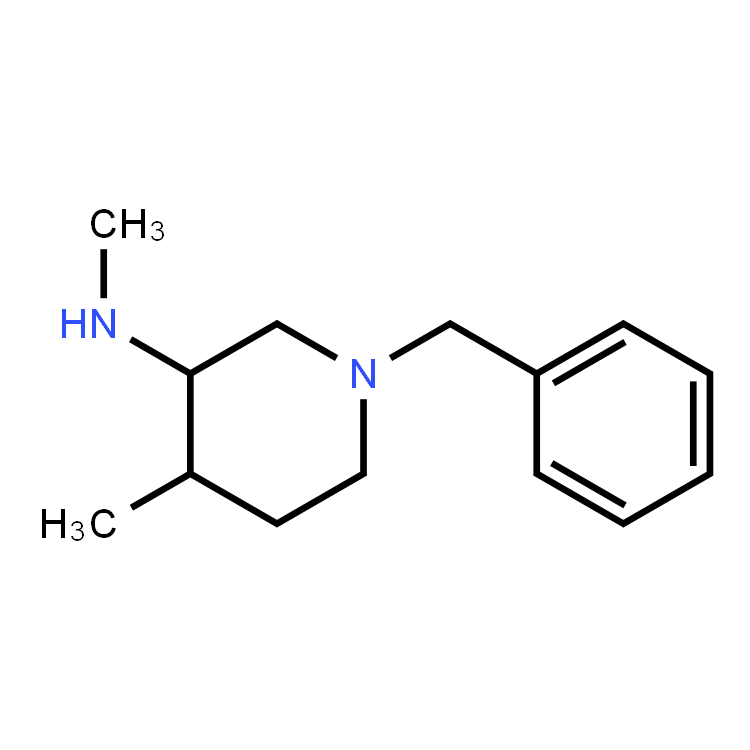
N,4-Dimethyl-1-(phenylmethyl)-3-piperidinamine、384338-23-2
AI Product Description
*The following content is generated by AI and is for reference only.
N,4-Dimethyl-1-(phenylmethyl)-3-piperidinamine is a specialized organic compound belonging to the piperidine alkaloid family, characterized by its substituted amine structure. Its molecular formula is C13H20N2, corresponding to a molecular weight of approximately 204.31 g/mol. The compound features a piperidine ring substituted with a methyl group at the nitrogen position (N-methyl), another methyl group at the 4-position, and a benzyl group attached to the nitrogen atom, forming a tertiary amine with significant steric bulk and lipophilicity. While specific CAS registry numbers for this exact nomenclature variant may vary slightly depending on stereochemistry or salt forms in commercial databases, it is structurally related to various pharmacologically active piperidine derivatives used in medicinal chemistry.
This chemical serves primarily as an intermediate in the synthesis of complex pharmaceutical agents. Due to the presence of the basic nitrogen center and the aromatic benzyl moiety, it exhibits versatile reactivity suitable for nucleophilic substitution, acylation, and alkylation reactions. Researchers frequently utilize such compounds as building blocks in the development of central nervous system (CNS) active drugs, including analgesics, antidepressants, and antipsychotics, where the piperidine scaffold is crucial for receptor binding affinity. Furthermore, its structural similarity to known bioactive molecules makes it valuable in Structure-Activity Relationship (SAR) studies aimed at optimizing drug potency and metabolic stability. In industrial applications, it may function as a catalyst precursor or a ligand in asymmetric synthesis, facilitating the production of high-value chiral compounds. Handling requires standard laboratory safety protocols, as amines can be corrosive and potentially toxic upon ingestion or inhalation. Storage should be conducted in cool, dry conditions under inert atmospheres to prevent oxidation or degradation. Although not widely available as a standalone consumer product, it remains a critical asset in advanced organic synthesis laboratories and pharmaceutical research facilities dedicated to novel therapeutic discovery.





 (All Rights Reserved)
![8-Oxa-1,3-diazaspiro[4.5]decane-2,4-dione](https://eimg.pharmasources.com/image/product/20250403/60fa7223d5a34f24138486ceea0ffb15jpg)
![6,8-Dioxo-5,7-diazaspiro[3.4]octane-2-carboxylic acid](https://eimg.pharmasources.com/image/product/20250403/02effeb5a7639bc84ff1f3add3c0c64fjpg)
![8,16-Diazadispiro[6.1.6.2]heptadecan-17-one](https://eimg.pharmasources.com/image/product/20250403/ca91cba8b87e53fc879f8d8764873a40jpg)