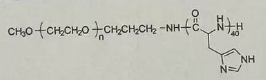
mPEG-P (His) is a block copolymer composed of methoxy polyethylene glycol (mPEG) and polyhistidine (P (His)), in which the P (His) chain contains 40 histidine units. This polymer has a wide range of applications in drug delivery, nanotechnology, and biomaterials, particularly in pH-responsive drug delivery systems.
*The following content is generated by AI and is for reference only.
mPEG-P(His)₄₀, or methoxy polyethylene glycol-block-poly(L-histidine), is a sophisticated amphiphilic block copolymer widely utilized in advanced biomedical research and drug delivery systems. Composed of a hydrophilic methoxy-poly(ethylene glycol) (mPEG) segment covalently linked to a hydrophobic poly(L-histidine) chain containing approximately forty histidine residues, this macromolecule exhibits unique stimuli-responsive properties essential for modern nanomedicine. While specific CAS registry numbers for custom-synthesized polymer batches may vary depending on the exact molecular weight distribution and end-group modifications, it is generally categorized under polymer science databases without a single universal CAS number like small molecules. Its primary utility lies in its ability to form stable micelles or nanoparticles that encapsulate hydrophobic therapeutic agents, such as anticancer drugs, thereby enhancing solubility and bioavailability.
The defining characteristic of mPEG-P(His)₄₀ is its pH-sensitive behavior driven by the imidazole side chains of the histidine residues. At physiological pH (approximately 7.4), the polymer remains relatively hydrophobic, stabilizing the core of drug-loaded nanoparticles. However, upon encountering the acidic microenvironment typical of tumor tissues or endosomal compartments (pH 5.0–6.5), the histidine residues become protonated. This protonation induces a conformational change that increases hydrophilicity, triggering rapid disassembly of the nanoparticle structure and facilitating the controlled release of the payload directly at the target site. This mechanism significantly reduces systemic toxicity and improves therapeutic efficacy compared to conventional non-targeted formulations. Furthermore, the mPEG corona provides a "stealth" effect, prolonging circulation time by evading recognition by the reticuloendothelial system. Consequently, mPEG-P(His)₄₀ serves as a critical building block for developing next-generation smart drug carriers, gene therapy vectors, and diagnostic imaging agents, representing a pivotal advancement in precision medicine strategies aimed at overcoming biological barriers.


![6-broMo-2-chloro-8-cyclopentyl-5-Methylpyrido[2,3-d]pyriMidin-7(8H)-one](https://eimg.pharmasources.com/image/20250617/4zoOybJjzUTk0UgguabMkX7VnrDIlxHluERwqkjK.jpg)




 (All Rights Reserved)