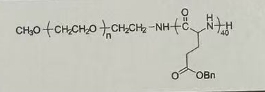
mPEG-P (BLG) is a block copolymer composed of methoxy polyethylene glycol (mPEG) and poly-benzyl-L-glutamate (Poly (γ-benzyl-L-glutamate), P (BLG)), in which the P (BLG) chain contains 40 benzyl-L-glutamate units. This polymer has a wide range of applications in the fields of drug delivery, nanotechnology, and biomaterials.
*The following content is generated by AI and is for reference only.
mPEG-P(BLG)₄₀ is a sophisticated amphiphilic block copolymer widely utilized in advanced biomedical applications, particularly within the fields of drug delivery and tissue engineering. This macromolecule consists of two distinct segments: a hydrophilic poly(ethylene glycol) (mPEG) chain and a hydrophobic poly(L-glutamate) (BLG) backbone containing forty L-glutamic acid units. While specific CAS registry numbers for this exact polymer variant are often not assigned due to its nature as a defined synthetic oligomer rather than a simple small molecule, it is generally synthesized through the ring-opening polymerization of N-carboxyanhydride (NCA) derivatives of L-glutamate initiated by methoxy-polyethylene glycol amine. The resulting structure features a well-defined molecular weight distribution, ensuring high reproducibility for clinical translation.
The primary utility of mPEG-P(BLG)₄₀ lies in its ability to self-assemble into stable nanostructures, such as micelles or vesicles, when dispersed in aqueous environments. The hydrophobic BLG core provides an ideal reservoir for encapsulating poorly water-soluble therapeutic agents, including anticancer drugs like paclitaxel or doxorubicin, while the hydrophilic PEG corona significantly enhances biocompatibility and prolongs circulation time by evading recognition by the reticuloendothelial system. Furthermore, the polyglutamate segment offers unique advantages; it is biodegradable, breaking down into non-toxic amino acids via enzymatic hydrolysis, and possesses abundant carboxyl groups that facilitate facile conjugation with targeting ligands or fluorescent markers for multimodal imaging.
Beyond oncology, this polymer serves as a versatile scaffold for gene delivery, where it can complex with nucleic acids to protect them from degradation. Its tunable architecture allows researchers to modulate release kinetics and cellular uptake efficiency precisely. As a result, mPEG-P(BLG)₄₀ represents a critical component in next-generation nanomedicine, bridging the gap between material science and therapeutic efficacy to treat complex diseases with minimal systemic toxicity.


![6-broMo-2-chloro-8-cyclopentyl-5-Methylpyrido[2,3-d]pyriMidin-7(8H)-one](https://eimg.pharmasources.com/image/20250617/4zoOybJjzUTk0UgguabMkX7VnrDIlxHluERwqkjK.jpg)



 (All Rights Reserved)