Product Description
MOF-74-Ni、882977-00-6
AI Product Description
*The following content is generated by AI and is for reference only.
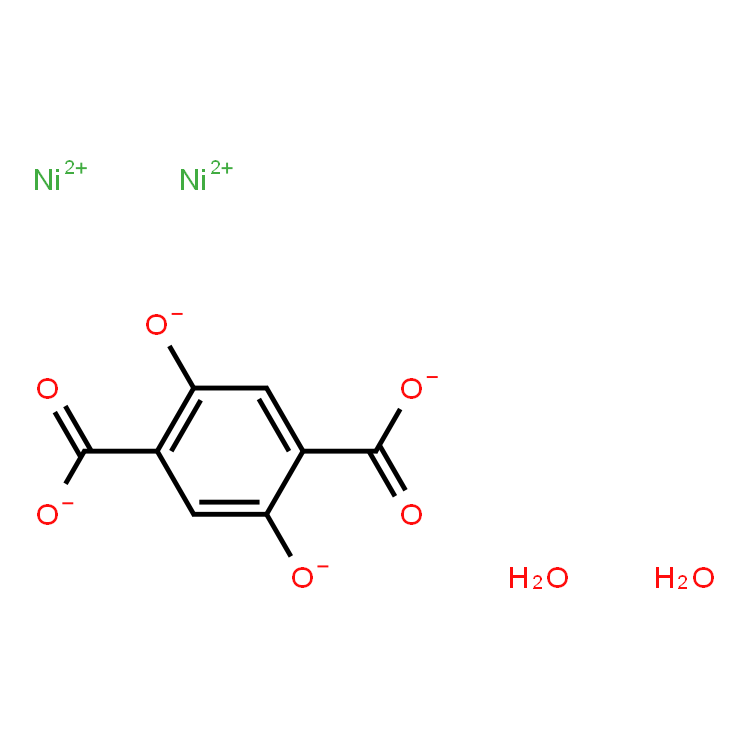
MOF-74-Ni, chemically designated as Nickel(II) 2,5-dihydroxyterephthalate or Ni-MOF-74, represents a prominent member of the metal-organic framework family. Its molecular formula is typically expressed as C8H4NiO6 when considering the simplest repeating unit containing one nickel ion coordinated to the organic linker, though the full stoichiometry often reflects the solvent molecules trapped within the porous structure. While specific CAS numbers can vary depending on the exact synthesis method and hydration state, it is frequently associated with identifiers for the parent compound or specific commercial variants, such as those linked to the 2,5-dihydroxyterephthalic acid precursor. This material crystallizes in a hexagonal space group, characterized by an open framework where nickel ions are arranged in chains connected by carboxylate groups from the organic linkers, creating uniform, one-dimensional channels.
The primary application of MOF-74-Ni lies in gas separation and storage technologies. Due to its high density of open metal sites, it exhibits exceptional affinity for small polar molecules, making it highly effective for capturing carbon dioxide (CO2) from flue gases or natural streams at ambient temperatures. It also demonstrates superior performance in storing hydrogen and methane, offering potential solutions for clean energy transportation and storage infrastructure. Beyond energy applications, researchers utilize this material for catalytic processes, leveraging the accessible nickel centers to facilitate oxidation reactions or other chemical transformations. Its structural stability under moderate conditions allows for repeated adsorption-desorption cycles without significant degradation. Furthermore, MOF-74-Ni serves as a vital model system in academic research for studying host-guest interactions and understanding the fundamental principles of porosity and selectivity in crystalline solids. Commercially available forms are increasingly used in industrial pilot projects aimed at reducing greenhouse gas emissions. As the demand for efficient carbon capture technologies grows, MOF-74-Ni stands out as a versatile, high-performance candidate for next-generation filtration systems and sustainable chemical engineering solutions, bridging the gap between laboratory innovation and practical environmental remediation.





 (All Rights Reserved)
![8-Oxa-1,3-diazaspiro[4.5]decane-2,4-dione](https://eimg.pharmasources.com/image/product/20250403/60fa7223d5a34f24138486ceea0ffb15jpg)
![6,8-Dioxo-5,7-diazaspiro[3.4]octane-2-carboxylic acid](https://eimg.pharmasources.com/image/product/20250403/02effeb5a7639bc84ff1f3add3c0c64fjpg)
![8,16-Diazadispiro[6.1.6.2]heptadecan-17-one](https://eimg.pharmasources.com/image/product/20250403/ca91cba8b87e53fc879f8d8764873a40jpg)