Product Description
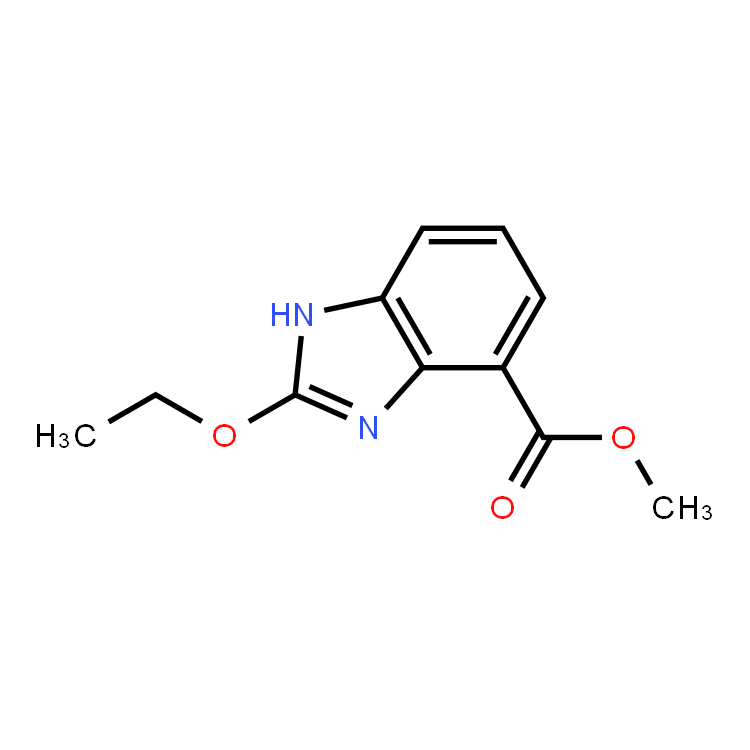
Methyl 2-ethoxybenzimidazole-7-carboxylate、150058-27-8
AI Product Description
*The following content is generated by AI and is for reference only.
Methyl 2-ethoxybenzimidazole-7-carboxylate is a specialized organic compound widely recognized in the fields of medicinal chemistry and agrochemical research. Its molecular formula is C12H14N2O3, reflecting a structure that combines a benzimidazole core with an ethoxy substituent at the second position and a methyl ester group at the seventh position. While specific CAS registry numbers can vary slightly depending on the exact isomer or supplier documentation, this compound generally falls under the classification of substituted heterocyclic esters used primarily as synthetic intermediates rather than final commercial products.
The primary utility of Methyl 2-ethoxybenzimidazole-7-carboxylate lies in its role as a versatile building block for the synthesis of biologically active molecules. The benzimidazole ring system is a privileged scaffold in drug discovery, frequently found in pharmaceuticals targeting central nervous system disorders, cardiovascular conditions, and anti-ulcer agents. By incorporating this specific derivative, chemists can introduce structural diversity to create novel analogues with improved pharmacokinetic profiles or enhanced potency. In agricultural science, similar derivatives are often investigated for their potential as fungicides or herbicides, leveraging the biological activity inherent to the heterocyclic framework.
Synthetically, the presence of the methyl ester group offers a convenient handle for further chemical modification. It allows for hydrolysis into the corresponding carboxylic acid or transesterification reactions, facilitating the attachment of various side chains required to optimize target binding affinity. Furthermore, the ethoxy group at the C-2 position influences the electronic properties and steric environment of the molecule, which can be critical for modulating metabolic stability in vivo. Researchers utilize this compound in laboratory settings to explore structure-activity relationships (SAR), aiming to develop next-generation therapeutics with reduced toxicity and higher selectivity. Due to its complexity, handling requires standard laboratory safety protocols, including the use of appropriate personal protective equipment and ventilation systems to manage potential exposure to organic solvents and fine particulates during processing. Ultimately, while not a consumer-facing product, it remains an essential tool for advancing chemical innovation in healthcare and agriculture sectors.











 (All Rights Reserved)
![8-Oxa-1,3-diazaspiro[4.5]decane-2,4-dione](https://eimg.pharmasources.com/image/product/20250403/60fa7223d5a34f24138486ceea0ffb15jpg)
![6,8-Dioxo-5,7-diazaspiro[3.4]octane-2-carboxylic acid](https://eimg.pharmasources.com/image/product/20250403/02effeb5a7639bc84ff1f3add3c0c64fjpg)
![8,16-Diazadispiro[6.1.6.2]heptadecan-17-one](https://eimg.pharmasources.com/image/product/20250403/ca91cba8b87e53fc879f8d8764873a40jpg)