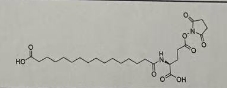
L-HO-Pal-Glu (OSu) -OH is an important intermediate in peptide synthesis. It is mainly used to introduce palmitoyl groups into polypeptides and provide the possibility of further modification through free hydroxyl and carboxyl groups. It has a wide range of applications in drug development, vaccine design and biochemical research
*The following content is generated by AI and is for reference only.
L-HO-Pal-Glu(OSu)-OH, chemically known as N-ω-(N-succinimidyl)palmitoyl-L-glutamic acid or L-glutamic acid ω-palmitoyl-N-succinimide ester, is a specialized bioconjugation reagent widely utilized in peptide chemistry and protein modification. Its molecular formula is C25H36N2O7, with a precise molecular weight of approximately 480.56 g/mol. This compound does not possess a standard CAS registry number due to its status as a custom synthetic intermediate often produced for specific research applications rather than commercial bulk distribution; however, it is frequently cataloged under internal supplier identifiers within chemical databases.
The primary utility of this molecule lies in its dual functionality: the glutamic acid backbone provides a carboxylic acid group for further coupling, while the succinimidyl (OSu) ester moiety serves as a highly reactive electrophile targeting primary amines. Upon reaction with amine-containing biomolecules such as proteins, peptides, or amino-functionalized surfaces, the OSu group facilitates the formation of stable amide bonds, effectively attaching the hydrophobic palmitoyl chain to the target. This palmitoylation process significantly alters the physicochemical properties of the modified substrate, enhancing membrane affinity and lipophilicity. Consequently, L-HO-Pal-Glu(OSu)-OH is indispensable in drug delivery systems, where it aids in anchoring therapeutic peptides into lipid bilayers, thereby improving cellular uptake and metabolic stability. It also finds application in creating amphiphilic block copolymers and studying protein-membrane interactions in biochemical assays. The synthesis typically involves activating the carboxyl group of palmitoylated glutamic acid with N-hydroxysuccinimide and a carbodiimide coupling agent. Due to the sensitivity of the active ester to moisture, storage requires anhydrous conditions at low temperatures to maintain reactivity. Researchers utilize this reagent to engineer membrane-permeable drugs, design fluorescent probes with enhanced localization, and develop novel lipid-peptide conjugates for targeted therapies, making it a critical tool in modern medicinal chemistry and biotechnology for modulating biological activity through controlled lipidation.


![6-broMo-2-chloro-8-cyclopentyl-5-Methylpyrido[2,3-d]pyriMidin-7(8H)-one](https://eimg.pharmasources.com/image/20250617/4zoOybJjzUTk0UgguabMkX7VnrDIlxHluERwqkjK.jpg)
![6,8-Dioxo-5,7-diazaspiro[3.4]octane-2-carboxylic acid](https://eimg.pharmasources.com/image/product/20250403/02effeb5a7639bc84ff1f3add3c0c64fjpg)
![8,16-Diazadispiro[6.1.6.2]heptadecan-17-one](https://eimg.pharmasources.com/image/product/20250403/ca91cba8b87e53fc879f8d8764873a40jpg)
![8-Oxa-1,3-diazaspiro[4.5]decane-2,4-dione](https://eimg.pharmasources.com/image/product/20250403/60fa7223d5a34f24138486ceea0ffb15jpg)



 (All Rights Reserved)