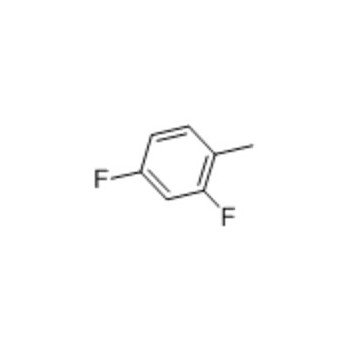
Product Description
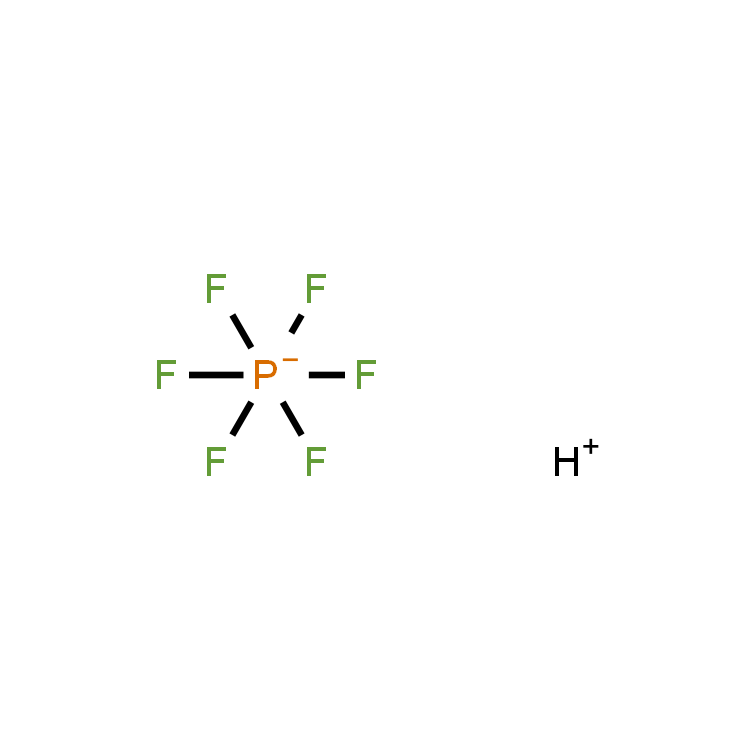
Hexafluorophosphoric acid、16940-81-1
AI Product Description
*The following content is generated by AI and is for reference only.
Hexafluorophosphoric acid, chemically designated as HPF₆, is a powerful inorganic acid characterized by its exceptional stability and unique solvation properties. With the molecular formula HPF₆ and CAS Registry Number 16943-20-5, this compound exists typically as a colorless to pale yellow liquid or aqueous solution. It is generated through the reaction of phosphorus pentachloride with anhydrous hydrogen fluoride or by treating hexafluorophosphate salts with strong acids. The molecule features a central phosphorus atom surrounded by six fluorine atoms, forming a robust octahedral geometry that contributes significantly to its chemical inertness toward many organic substrates compared to other halogenated acids.
Due to its high acidity and non-nucleophilic nature, hexafluorophosphoric acid serves as a critical reagent in various advanced industrial applications. Its primary utility lies in the synthesis of organometallic catalysts and coordination complexes, particularly within the realm of homogeneous catalysis where it stabilizes cationic metal centers. In the pharmaceutical industry, it is frequently employed as a counter-ion source for generating stable hexafluorophosphate salts of amine-based drugs, enhancing their solubility and crystallinity for formulation purposes. Furthermore, the compound plays a pivotal role in the production of lithium-ion battery electrolytes, where lithium hexafluorophosphate (LiPF₆) is derived from HPF₆ precursors to ensure optimal ionic conductivity and electrochemical stability.
Safety protocols are paramount when handling this substance, as it acts as a severe irritant to skin, eyes, and respiratory tract tissues. Upon contact with water, it releases corrosive fumes, necessitating storage in tightly sealed containers away from moisture and incompatible materials like bases or oxidizers. Despite these hazards, its unparalleled ability to facilitate complex chemical transformations makes it indispensable in modern chemical manufacturing, research laboratories, and high-tech material science sectors, driving innovation in energy storage and fine chemical synthesis globally.





 (All Rights Reserved)
![8-Oxa-1,3-diazaspiro[4.5]decane-2,4-dione](https://eimg.pharmasources.com/image/product/20250403/60fa7223d5a34f24138486ceea0ffb15jpg)
![6,8-Dioxo-5,7-diazaspiro[3.4]octane-2-carboxylic acid](https://eimg.pharmasources.com/image/product/20250403/02effeb5a7639bc84ff1f3add3c0c64fjpg)

![8,16-Diazadispiro[6.1.6.2]heptadecan-17-one](https://eimg.pharmasources.com/image/product/20250403/ca91cba8b87e53fc879f8d8764873a40jpg)